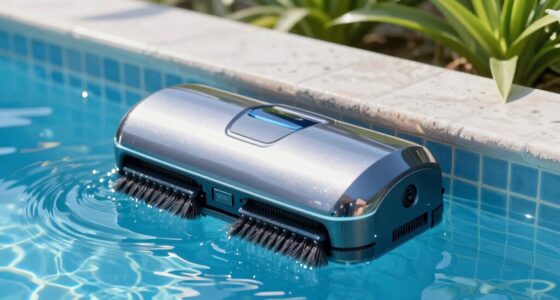
When shopping for an automatic pool cleaner, the central choice is often between a robotic model and a suction-side model. Both can reduce routine brushing and vacuuming, but they work differently: a robot has its own drive and filter, while a suction cleaner connects to the pool’s circulation system and sends debris through the pool filter. That distinction affects cleaning coverage, energy use, setup, and ongoing maintenance.

Get pool and patio gear delivered free with Prime
- Fast, free delivery on millions of items
- Prime Video, Amazon Music and more included
- Member-only deals all year

WYBOT C1 Cordless Robotic Pool Vacuum for Inground Pools, Professional
- ✔ Power: Rechargeable lithium-ion battery
- ✔ Stated maximum runtime: Up to 160 minutes
- ✔ Stated charging time: 4 hours

Dolphin Automatic Robotic Pool Vacuum Cleaner, Wall Climbing Scrubber Brush, Smart Navigation, Ideal for In-Ground Pools up to 40…
- ✔ Power: AC/DC, plug-and-play
- ✔ Stated pool length: Up to 40 ft.
- ✔ Cleaning cycle: 2 hours

Dolphin Nautilus CC Automatic Robotic Pool Vacuum Cleaner, Wall Climbing Scrubber Brush, Top Load Filter Access, Ideal for Above/…
- ✔ Power: Corded electric
- ✔ Voltage: 230 V
- ✔ Stated pool length: Up to 33 ft.
Robotic cleaners usually make more sense for owners who want independent operation, targeted cleaning, and less added load on the pool pump. Suction-side cleaners suit buyers focused on a lower initial cost, especially when the pool already has a compatible connection and the existing pump runs regularly. The right choice depends less on the word “automatic” than on how much convenience is worth paying for and what your pool equipment can support.
At a Glance
| Criteria | Robotic pool cleaners | Suction-side pool cleaners | Winner |
|---|---|---|---|
| Upfront cost | Typically higher; prices vary by features and pool size | Typically lower, though required hoses or valves can add cost | B |
| Cleaning coverage | Many models clean the floor and may also climb walls or scrub the waterline | Primarily vacuums the floor; coverage depends on pool shape, suction, and model | A |
| Pump and energy use | Runs independently of the pool pump, though it still uses electricity | Uses the pool pump and filter, adding workload while it runs | A |
| Setup and compatibility | Usually needs a power supply and a suitable route for the cable | Needs a compatible suction port or skimmer connection and adequate pump flow | Depends |
| Debris handling | Collects debris in an onboard filter basket or bag | Sends debris into the pool’s filtration system | A |
| Routine maintenance | Requires cleaning its filter and checking tracks, brushes, and cable | Requires checking hoses and cleaner parts, plus more frequent pool-filter cleaning when debris is heavy | A |
| Best pool fit | Owners who prioritize independent cleaning and broader coverage | Owners seeking a lower-cost cleaner with compatible existing equipment | Depends |
WYBOT C1 Cordless Robotic Pool Vacuum for Inground Pools, Professional
The WYBOT C1 is the most versatile cleaner in this lineup on paper. Its stated 4-in-1 coverage includes the floor, walls, waterline, and steps, while the two Dolphin models are described as climbing walls and scrubbing surfaces without specifying step or waterline coverage. That wider target matters when a pool’s dirt collects around transitions and ledges as well as on the floor.Its cordless design and app controls also change the routine: owners can schedule cleaning and select modes without managing a power cable running to the pool. The tradeoff is that cleaning depends on a rechargeable battery, with a stated maximum runtime of 160 minutes and a four-hour charge. That makes cycle planning more relevant than with the Dolphins’ plug-and-play setup. WYBOT also specifies a 180-micron filter and suction up to 3,048 gallons per hour, but those figures should not be compared directly with the Dolphins because equivalent specs are not provided for them.We’d put this model first for pool owners who value freedom from a cord and want one machine to address more of the pool’s surfaces. Skip it if you want a simple powered unit with no battery to recharge, or if your pool exceeds its stated area or depth limits. Its feature set is broader than the Nautilus CC Plus, but the Dolphin’s two-hour cycle may suit buyers who prize a defined, plug-in routine.
Pros:
- Cordless operation avoids placing a power cord across the pool area.
- Stated coverage includes floor, walls, waterline, and steps.
- App supports scheduling, mode selection, and progress tracking.
- Up to 160 minutes of stated runtime, with navigation patterns intended to reduce missed areas.
Cons:
- The stated four-hour charging time requires planning between cleaning cycles.
- Maximum runtime and pool-size coverage may not suit every large or demanding pool.
- More app and battery features may be unnecessary for buyers seeking a basic plug-and-play routine.
Best for: Owners of in-ground pools within the stated size limits who want cordless operation, app scheduling, and floor-to-step coverage.
Not ideal for: Buyers who prefer a plug-in cleaner without battery charging, or whose pools exceed the stated 1,618-square-foot area or 9.86-foot depth limits.
Bottom line: Choose the WYBOT C1 when cordless movement and broader stated coverage matter more than avoiding battery charging.
“Choose the WYBOT C1 when cordless movement and broader stated coverage matter more than avoiding battery charging.”
Dolphin Automatic Robotic Pool Vacuum Cleaner, Wall Climbing Scrubber Brush, Smart Navigation, Ideal for In-Ground Pools up to 40…
For owners with a longer in-ground pool, the Nautilus CC Plus has the clearest size advantage among the corded options here: it is stated to suit pools up to 40 feet long. That gives it more room than the Nautilus CC’s 33-foot limit. Its wall-climbing active scrubber is intended to handle surfaces as it moves, and the top-load basket puts filter access at the top of the maintenance checklist.The Plus keeps operation deliberately simple. Its plug-and-play setup requires connecting power, placing the cleaner in the pool, and starting it; the stated cycle is two hours. This compares well with WYBOT for buyers who do not want to manage a battery or app, but the cord is a practical constraint and the description does not claim the broader waterline-and-steps coverage listed for WYBOT. Nor does the supplied product information specify the Plus’s navigation pattern in enough detail to compare it with WYBOT’s N- and S-path claims.We rank it ahead of the smaller Nautilus CC when pool length is the priority. It is a sensible choice for an in-ground pool within the 40-foot limit and for owners who prefer a defined powered cycle. Look elsewhere if cordless convenience, app scheduling, or explicitly stated step coverage is central to your decision. The product description also does not give a runtime beyond the two-hour cleaning cycle, so buyers should confirm that this coverage suits their pool’s shape and cleaning needs.
Pros:
- Stated pool-length limit of up to 40 feet, the largest among these three models.
- Wall-climbing design with an active scrubbing brush.
- Two-hour stated cleaning cycle and plug-and-play operation.
- Top-load filter basket allows access from above for routine cleaning.
Cons:
- Corded operation requires managing the cable around the pool.
- The supplied description does not specify waterline or step coverage.
- App control and battery operation are not listed as features.
Best for: Owners of in-ground pools up to 40 feet long who want wall scrubbing and a straightforward plug-in cleaning cycle.
Not ideal for: Cord-sensitive pool layouts, buyers who want cordless app control, or owners who need explicitly stated waterline and step cleaning.
Bottom line: Pick the Nautilus CC Plus for a larger in-ground pool when a simple, corded wall-scrubbing cycle is the priority.
“Pick the Nautilus CC Plus for a larger in-ground pool when a simple, corded wall-scrubbing cycle is the priority.”
Dolphin Nautilus CC Automatic Robotic Pool Vacuum Cleaner, Wall Climbing Scrubber Brush, Top Load Filter Access, Ideal for Above/…
The Nautilus CC is the more compact-fit choice for a pool up to 33 feet long, and its stated suitability includes both above-ground and in-ground pools. That wider pool-type description helps distinguish it from the Plus, which is presented for in-ground pools up to 40 feet. For a smaller pool, paying attention to that fit may matter more than choosing the model with the longest stated reach.Like the Plus, this cleaner combines wall climbing, an active scrubber, and a top-load filter basket with plug-and-play operation and a stated two-hour cycle. The basic cleaning approach is therefore familiar across the Dolphin pair; the key decision is pool fit and setup context. Compared with WYBOT, the Nautilus CC gives up cordless operation, app scheduling, and explicitly described cleaning of waterline and steps. In return, its listed features avoid the additional battery-charging routine.We’d favor the CC for an owner who wants a simple cleaner for a shorter pool and values the stated above-ground compatibility. It is less compelling for pools longer than 33 feet, where the Plus has a higher stated limit, or for owners seeking the broadest surface coverage described in this roundup. The listing calls out a 230-volt supply; check compatibility with your poolside power setup before choosing. Like the other Dolphin, it is corded, so plan for cable handling as part of regular use.
Pros:
- Stated compatibility covers above-ground and in-ground pools.
- Wall-climbing design and active scrubbing brush.
- Two-hour stated cleaning cycle with plug-and-play setup.
- Top-load basket keeps routine filter access straightforward.
Cons:
- Stated pool-length limit is lower than the Nautilus CC Plus.
- Corded operation does not offer WYBOT’s cordless convenience.
- Listing specifies 230 volts, so buyers should confirm their power setup.
Best for: Owners of above-ground or in-ground pools up to 33 feet long who want plug-and-play operation and wall scrubbing.
Not ideal for: Owners of longer pools, buyers who need cordless operation, or anyone prioritizing listed step and waterline coverage.
Bottom line: Choose the Nautilus CC for a smaller above-ground or in-ground pool when a simple corded cleaner is enough.
“Choose the Nautilus CC for a smaller above-ground or in-ground pool when a simple corded cleaner is enough.”
As an Amazon Associate we earn from qualifying purchases.
Key Differences
The biggest practical difference is where the cleaning work happens. A robotic cleaner circulates and filters water within the pool using its own motor and debris container. A suction-side cleaner relies on the pool pump to draw water and debris through a hose and into the pool’s filter. That makes suction models less expensive to buy in many cases, but the cleaner’s performance and operating burden are tied to the pool’s circulation setup.
Coverage also separates the categories. Many robots can climb walls and scrub more than the floor, while suction-side cleaners are generally designed for floor debris. Specific performance varies by model, and pool shape, surface, and debris all matter. Owners who need frequent wall or waterline cleaning should check a robot’s stated coverage rather than assume every model handles those areas.
For value, compare the purchase price with how often you clean, how much debris the pool collects, and whether you already run the pump for long periods. A suction cleaner can be the sensible budget choice when the connection and filtration system are ready. A robot’s higher cost can pay off for owners who want independent cycles and broader cleaning, or who would otherwise run the main pump specifically to vacuum.
Detailed Comparison
Upfront cost (Suction-side pool cleaners wins — moderate)
Suction-side cleaners usually win on initial purchase price, a moderate difference for buyers working within a tight budget. They can use equipment already installed at the pool, though extra hose or connection parts may narrow the gap. Robots cost more up front, so their premium is easiest to justify when their added independence and coverage will be used often.
Cleaning coverage (Robotic pool cleaners wins — major)
Robots usually win, often by a major margin when wall or waterline cleaning matters. Many models are built to climb walls and scrub surfaces; suction cleaners mostly target the floor. Check the exact model, since neither category guarantees ideal coverage in every pool or with every surface and shape.
Pump and energy use (Robotic pool cleaners wins — moderate)
Robots have the advantage because they clean without using the pool’s main pump to create suction. That can reduce the extra pump runtime required for cleaning, although the robot itself still consumes electricity. Suction cleaners add work to the pump and filter while operating, so the practical cost depends on the pump, schedule, and how long cleaning takes.
Setup and compatibility (moderate difference)
There is no universal winner. A suction cleaner is straightforward when the pool has a compatible port or skimmer connection and enough flow; without those, installation or performance can be a problem. A robot avoids suction compatibility questions but needs an appropriate power supply and cable reach. The existing pool layout decides which setup is easier.
Debris handling (Robotic pool cleaners wins — moderate)
Robots have a moderate advantage for owners who want to keep collected debris out of the pool’s main filter: debris goes into an onboard basket or bag. A suction cleaner sends debris into the pool filtration system, which is convenient for small amounts but can mean more filter cleaning during heavy leaf or grit seasons.
Routine maintenance (Robotic pool cleaners wins — moderate)
Robots generally win by a minor to moderate margin because their debris container can be emptied separately. They still need filter and component care. Suction cleaners are mechanically simple, but their hoses need inspection and the pool’s filter may need more frequent attention as it catches the cleaner’s debris. The amount of upkeep depends heavily on pool conditions.
Best pool fit (moderate difference)
This depends on the owner’s priorities and equipment. A robot is a stronger match for pools where independent operation and broad surface coverage matter. A suction cleaner is a good fit when the pool already has a compatible connection, the pump runs on a suitable schedule, and keeping upfront spending down is the priority.
Robotic pool cleaners: Pros and Cons
Pros:
- Independent motor and filtration system
- Many models clean floors and climb walls
- Does not require suction from the pool’s main pump
- Onboard filter captures debris for separate removal
Cons:
- Higher purchase price in most cases
- Needs a suitable power supply and cable reach
- Filter and moving components need regular care
- Capabilities vary by model, so coverage claims require checking
Suction-side pool cleaners: Pros and Cons
Pros:
- Usually lower initial purchase cost
- Can use the pool’s existing pump and filtration system
- No separate powered cleaning unit is required
- Can be a practical fit when a compatible suction connection is already installed
Cons:
- Depends on pump flow and compatible plumbing
- Typically focuses on floor cleaning rather than wall or waterline scrubbing
- Adds workload to the pool pump and filter
- Heavy debris can mean more frequent pool-filter cleaning
Who Should Choose What
Choose Robotic pool cleaners if:
- You want a cleaner that operates independently of the pool pump.
- Your pool needs regular wall or waterline cleaning, and the selected model supports it.
- You prefer debris to collect in a separate basket rather than the pool filter.
- You clean often enough that convenience and broader coverage justify a higher purchase price.
Choose Suction-side pool cleaners if:
- Keeping the initial purchase cost low is your main priority.
- Your pool already has a compatible suction port or skimmer setup and adequate pump flow.
- Most of the debris you need to remove is on the pool floor.
- You are comfortable with the cleaner relying on the pool pump and filter.
Skip both if: Skip both until you confirm compatibility if your pool has unusual plumbing, a weak or incompatible pump setup, or surfaces that the cleaner’s manufacturer does not support.
Value for Money
Suction-side cleaners are often the better value for owners who already have the right connection, run the pump on a schedule that accommodates cleaning, and mainly need floor debris removed. The lower purchase price matters most when the cleaner’s narrower coverage matches the job.
Pay more for a robotic cleaner when independent operation, onboard debris collection, or wall cleaning will make a regular difference to pool care. A robot is not automatically the cheaper option over time: electricity, replacement parts, and how it changes pump runtime all vary. Compare the specific models and your pool schedule before treating the higher price as an investment that will pay for itself.
Final Verdict
For owners who want broader cleaning coverage and a unit that works independently of the pool pump, a robotic cleaner is the stronger choice. Its higher price is justified when those features will be used regularly. Choose a suction-side cleaner when upfront cost matters more, your pool already has a compatible connection, and floor cleaning is enough. The deciding factor is whether independent operation and added coverage are worth paying extra for; if not, suction is the more economical starting point.
Frequently Asked Questions
Are robotic pool cleaners worth the extra cost?
They can be for owners who clean often, need wall coverage, or want cleaning separated from the pool pump. If you mainly need occasional floor vacuuming and already have compatible suction plumbing, the extra cost may not buy enough practical benefit.
Does a suction-side cleaner use the pool’s filter?
Yes. It draws water and debris through the pool’s circulation system, so debris reaches the pool filter. During heavy debris periods, expect to check or clean that filter more often.
Which type is better for leaves?
It depends on leaf volume and the specific model. A robot with an appropriately sized debris basket can keep leaves out of the pool filter. A suction cleaner can pick up debris too, but a large amount may load the pool filter quickly.
Can a suction-side cleaner replace a robotic cleaner?
It can replace one for basic floor cleaning if the pool has compatible plumbing and the pump provides sufficient flow. It generally will not match a robot’s independent operation or the wall-cleaning capability offered by many robotic models.