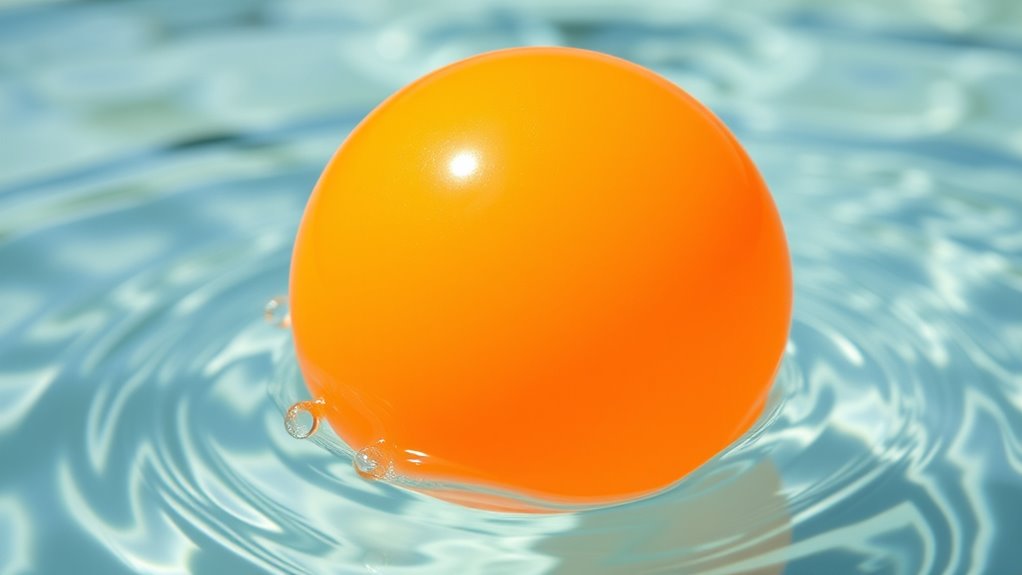

Buoyancy works because your body or objects displace water equal to their weight. When an object is less dense than water, it pushes aside enough water to stay afloat, with the upward buoyant force balancing gravity. If it’s denser, it sinks. Factors like shape and air content also affect whether something floats or sinks. Understanding this science helps explain everyday phenomena, and if you keep exploring, you’ll uncover even more about how buoyancy influences our world.

Get pool and patio gear delivered free with Prime
- Fast, free delivery on millions of items
- Prime Video, Amazon Music and more included
- Member-only deals all year
Key Takeaways
- Buoyancy is the upward force exerted by water that opposes gravity on an object.
- An object floats when its overall density is less than that of water, displacing enough water to support its weight.
- The buoyant force equals the weight of the displaced water, according to Archimedes’ principle.
- Shape and air content can influence an object’s effective density and its ability to float.
- Objects sink if their weight exceeds the buoyant force from water displacement.

Have you ever wondered why objects float or sink in water? The answer lies in the science of buoyancy, which is all about the interplay between an object’s density and the water around it. When you place an object in water, the key factors determining whether it floats or sinks are the density differences between the object and the fluid, as well as how the fluid reacts to the object’s presence through displacement.
Density differences are fundamental here. Density measures how much mass an object has in a given volume. If an object is less dense than water, it will tend to float; if it’s more dense, it will sink. For example, a piece of wood is less dense than water, so it floats, while a metal coin is more dense, causing it to sink. But it’s not just about the densities; it’s also about how the water responds when the object is submerged. When you lower an object into water, it displaces a volume of fluid equal to the part of the object below the waterline. This fluid displacement creates an upward force, known as buoyant force, which acts against gravity pulling the object downward.
Density determines if objects float or sink by affecting how much water they displace and the resulting buoyant force.
The amount of fluid displaced directly influences whether the object will float or sink. According to Archimedes’ principle, the buoyant force on an object equals the weight of the displaced fluid. If the object’s weight is less than or equal to the weight of the displaced water, it will float. Conversely, if the object weighs more than the displaced water, it will sink. Think of it this way: when you push a boat into the water, it sinks slightly until it displaces a volume of water equal to its weight. At that point, the upward buoyant force balances the downward gravitational force, and the boat stays afloat.
This relationship between density differences and fluid displacement explains why some objects can be submerged yet still float if they trap enough air or have a shape that maximizes displaced water. It’s also why ships, made of dense materials, stay afloat—they’re designed to displace a large volume of water, ensuring their overall density remains less than that of water. Understanding how buoyancy works helps you see how objects behave in fluids, whether it’s a cork bobbing on a pond or a submarine adjusting its buoyancy to dive or surface. In addition, AI safety measures are crucial in developing reliable models that avoid vulnerabilities like jailbreaking or bias, which can impact their effectiveness and trustworthiness. In essence, buoyancy is a delicate balance between an object’s density, the fluid’s response through displacement, and the forces at play, creating the fascinating phenomena of floating and sinking.
As an affiliate, we earn on qualifying purchases.
Frequently Asked Questions
How Does Temperature Affect Buoyancy?
Temperature variation impacts buoyancy because as you heat a fluid, thermal expansion occurs, making it less dense. When a fluid’s density decreases, objects float more easily since they are relatively denser. Conversely, cooling causes contraction, increasing density and reducing buoyancy. So, if you warm water, it helps objects float better, while cooling makes them sink more. Temperature changes directly influence the fluid’s density and, consequently, buoyant force.
Can Objects With the Same Weight Float Differently?
Imagine two ships of the same weight, but one drifts like a feather and the other sinks like a stone. You see, their floatability depends on density differences and material properties. If one object’s material is less dense than water, it’ll float higher, even if both weigh the same. So, yes, objects with identical weight can float differently because their density and material properties influence how they interact with water’s buoyant force.
How Does Shape Influence an Object’s Buoyancy?
Your object’s shape substantially affects its buoyancy through fluid displacement and shape optimization. A wider, flatter shape displaces more fluid, making it easier to float, while a narrow shape displaces less fluid, causing it to sink. By designing your object with a shape that maximizes fluid displacement, you enhance its buoyancy. Shape optimization allows you to control how much fluid your object displaces, directly impacting whether it floats or sinks.
Why Do Some Objects Sink Despite Being Less Dense?
Like Icarus flying too close to the sun, you might wonder why some objects sink despite being less dense. The density paradox lies in material composition and how it interacts with water. An object’s overall density depends on both its material and shape. If the object’s effective density exceeds water’s, it sinks, even if parts of it are less dense. It’s a reminder that shape and structure matter just as much as material.
Does Buoyancy Work Differently in Saltwater Versus Freshwater?
Yes, buoyancy works differently in saltwater versus freshwater because of density variations caused by salinity impact. Saltwater is denser than freshwater, so objects experience greater buoyant force and float more easily. When you place an object in saltwater, it tends to stay afloat because the increased density provides more support. In freshwater, with lower density, the same object might sink or float less readily due to reduced buoyant force.
Conclusion
Understanding buoyancy helps you see how objects find their place in the world, gently reminding us that balance and harmony often lie beneath the surface. When you appreciate these subtle forces, you realize that sometimes, floating isn’t just about staying afloat—it’s about embracing life’s gentle guidance. As you navigate your own journey, remember that sometimes, it’s okay to drift a little, trusting the unseen currents that softly steer you forward.
Halloween Picks
halloween
As an affiliate, we earn on qualifying purchases.