TL;DR

Get pool and patio gear delivered free — and shop member deals
- Fast, free delivery on millions of items
- Access to Prime Big Deal Days deals on October 6–7
- Prime Video, Amazon Music and more included
An inflatable pool lounger is an air-filled float designed for reclining on water, and the best ones share three features: thick PVC or fabric-coated material (0.3mm or heavier), a reliable multi-chamber valve, and a stable base shape. Expect to pay $25–60 for one that lasts multiple seasons, versus $10 disposables that typically fail within weeks. Always supervise children near loungers — an inflatable is a toy, not a life-saving device.
The lounger that costs $9.99 at the drugstore checkout and the one that costs $45 online look almost identical in the box. One dies on its third weekend. The other survives three summers, two pool parties, and a Labrador retriever. The difference isn’t luck — it’s material thickness, valve design, and shape.
This guide covers what actually matters when you buy an inflatable pool lounger: the three features that predict durability, how to inflate one without passing out, how to keep it alive longer, and what most people get wrong about safety. Spoiler: an inflatable lounger is not a life jacket, and treating it like one is the single most dangerous mistake people make around pools.
By the end, you’ll know exactly what to look for — and what to ignore — before you spend a dollar.
Buy loungers with 0.3mm+ PVC, locking valves, and at least two air chambers — the three features that predict survival past one season.
Inflate to 80–90% and top off in the shade; fully-inflated chambers left in the sun stretch their seams and warp permanently.
A soft lounger in the morning is usually thermal contraction, not a leak — check overnight temperature drop before patching.
Rinse off chlorine, dry fully, and store deflated in a cool closet; these three habits roughly double a lounger’s usable life.
Inflatable loungers are toys, not life jackets — supervise children constantly and clear floats from the pool when swimming ends.
What an Inflatable Pool Lounger Actually Is (And What It Isn’t)
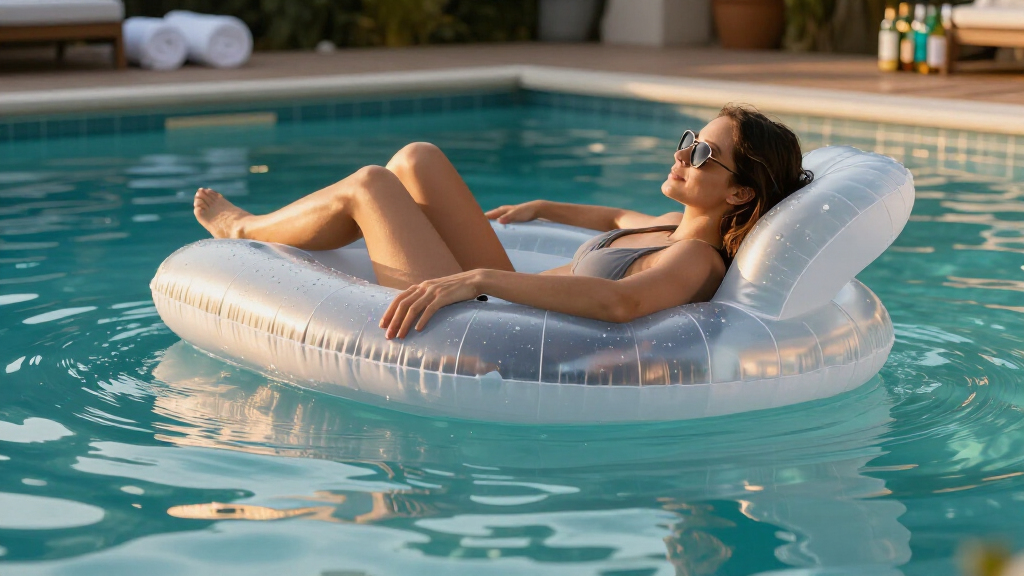
An inflatable pool lounger is an air-filled float designed for reclining — you lie back on it, partially submerged, with your head and torso supported above the waterline. It differs from a pool ring (which you sit inside of) and a raft (which keeps you fully dry). A lounger is about being in the water, not on it. That distinction matters more than it sounds: partial submersion is what keeps you cool on hot afternoons, because water carries heat away from your body far better than air. A fully dry raft trades comfort for sun exposure — which is why rafts dominate spring and fall pool days, and loungers dominate July.
Picture the difference on a 95°F afternoon. A raft keeps you dry but cooks you in the sun. A ring bobs you upright like a fishing bobber. A lounger lets you drift with your arms trailing in cool water, drink resting in the built-in cupholder, half-asleep. That’s the appeal — and why lounger designs dominate pool float sales every summer. The tradeoff is stability: because a lounger distributes your weight over a long, narrow air chamber, it’s more prone to tipping than a wide raft, especially when someone shifts position or climbs on from the side. Designers fight this with wider bases and multiple chambers, which is one reason lounger shapes vary so much between brands.
What a lounger isn’t is a safety device. It has no certification, no buoyancy rating for rescue, and it can deflate without warning — meaning its performance degrades exactly when you’d need it most. More on that in the safety section — it matters more than any feature comparison.
3 Features That Decide Whether Your Lounger Survives the Summer
The three features that determine inflatable lounger durability are material thickness, valve quality, and chamber count. Everything else — color, print, cupholders — is decoration. Here’s how to judge each one before you buy, and why each one matters.
- Material thickness of 0.3mm or more. Budget floats use 0.18–0.22mm PVC, which feels like a sandwich bag and punctures against rough pool plaster just as easily. Mid-range and premium loungers use 0.3–0.6mm PVC, sometimes with a fabric coating that feels like a beach ball from the 1990s — stiff, matte, and tough. Why thickness matters so much: a lounger’s failure mode isn’t usually a dramatic pop — it’s hundreds of tiny abrasions from pool edges, concrete decks, and sunscreen-oiled skin rubbing against the surface. Thicker material resists that slow grind. The tradeoff is weight and stiffness — a 0.6mm fabric-coated lounger is heavier to carry and harder to fold small, so if you backpack to a lake, a lighter 0.3mm model may be the smarter pick.
- A valve that locks, not just plugs. Cheap floats use a pinch-valve you hold shut with your finger while fumbling for the cap. Look for screw-cap or double-lock valves that seal themselves. The valve is the #1 slow-leak point on every inflatable ever made — and slow leaks are worse than punctures because they’re hard to diagnose. You lose a little air each day, blame the heat, and don’t discover the real cause until the float is too soft to use. A locking valve eliminates an entire category of silent failure for about $5 of extra manufacturing cost.
- Two or more air chambers. A single-chamber lounger with one puncture goes completely limp — with you on it. Multi-chamber designs keep half their buoyancy, which means you stay above water while you paddle to the edge. The implication goes beyond convenience: a multi-chamber lounger is effectively a redundancy system, which is why two-chamber designs survive punctures roughly twice as often. The tradeoff is inflation time — each chamber needs its own fill — but a locking-valve multi-chamber float at 90% pressure beats a single-chamber float at 100% every single time.
Rule of thumb: if the box doesn’t state material thickness, assume it’s thin. Manufacturers who use thick PVC always print the number.
Real-world check: a Sun Pleaser-style fabric lounger at around $40 typically lists 0.4mm PVC, 3 chambers, and locking valves. A $12 no-name float lists nothing but a flamingo print. That omission is the specification — and it tells you the manufacturer knows the number wouldn’t help them sell it.
How to Pick the Right Lounger for Your Pool (Quick Comparison)
The right inflatable lounger depends on who’s using it and how much space your pool has — a float that’s perfect for a 12-foot round above-ground pool is wrong for a lake day with waves. This table matches the four most common lounger styles to their best use, along with the tradeoff each style asks you to accept.
| Lounger Style | Best For | Typical Price | Watch Out For |
|---|---|---|---|
| Classic recliner (chair-back) | Reading, sipping, staying put | $25–45 | Tips backward if the backrest chamber underinflates |
| Full-length mat/tube lounger | Tanning, napping, tall users | $20–50 | Bulky to store; catches wind in outdoor pools |
| Hammock/saddle style | Sitting半-submerged, staying cool | $15–35 | Wetter ride — you’ll want a towel nearby |
| Canopy lounger (with shade) | Kids, fair skin, all-day sessions | $40–70 | Heavier; canopy catches wind and flips in breeze |
Pool size check: a full-length lounger runs 6–7 feet. In a small round pool, two of them fill the surface and block swim lanes. Measure your water’s shortest span before ordering anything longer than your torso. The deeper principle: in a small pool, every float competes for the same surface area, so compact or hammock styles give you more usable water per dollar of float.
Think of the choice as a tradeoff between three things you can’t maximize at once: comfort (recliners and full-length mats win), cooling (hammocks win — you’re wetter), and stability in wind (low-profile mats win; canopies lose). Decide which matters most for your pool and your typical afternoon, and the table picks itself.
Inflate It Right: The 5-Minute Method That Saves Your Lungs
You can inflate a lounger correctly in about five minutes using an electric pump or a hairdryer on cool setting — blowing it up by mouth takes 15–20 minutes of dizziness and adds moisture that degrades the interior over time. The moisture point matters more than people realize: humid air trapped inside a sealed chamber encourages interior mildew and material breakdown you can’t see until the seams start failing a season early. Follow this sequence every time.
- Lay the lounger flat on grass or a towel, never concrete. Invisible abrasion from pool decks is the most common cause of mystery leaks — tiny scratches that don’t fail immediately but weaken the material until heat and pressure finish the job weeks later.
- Fill each chamber 80–90% full. Air expands in the sun — a fully stuffed chamber left on hot plaster can stretch its seams and warp the shape permanently. Underinflation isn’t laziness; it’s engineering headroom. A chamber at 85% has room to expand safely when the deck hits 110°F.
- Top off in the shade, then cap each valve firmly and press the seam around it to check for hissing. Doing this in shade means you’re calibrating to a stable air temperature, not a moving target.
- Do the listen test: hold the float near your ear in a quiet spot. A slow leak sounds like a faint whisper at the valve or seam. Catching it now — before the float is in the water with someone on it — turns a potential mid-pool failure into a ten-minute patch job.
One scenario every owner hits: the lounger is soft by morning and you blame a puncture. Nine times out of ten it’s thermal contraction — air shrinks when overnight temperatures drop 15–20 degrees. The implication: repeatedly over-inflating a lounger to compensate for morning softness is how people blow out seams in July. Top it off in the shade instead, and assume the float is fine until proven otherwise.
Make It Last: Storage Habits That Double a Lounger’s Life
Inflatable loungers die from three things: sun, chlorine, and bad storage. Fix those and even a mid-priced float lasts multiple seasons instead of one. Understanding why each habit matters makes you more likely to keep it: these aren’t chores, they’re interrupts to three specific chemical and physical processes.
- Rinse with fresh water after each pool session. Chlorine residue keeps eating PVC long after you leave the water — it’s a slow oxidation that makes the material brittle and chalky over months. Rinsing stops the reaction; skipping it lets it run 24/7 in storage.
- Dry completely before storing — trapped moisture grows mildew that stains and weakens the material from the inside. Interior damage is the worst kind because you can’t see it or patch it; you only discover it when a seam lets go.
- Store deflated, folded loosely, in a cool closet. Never in a shed or car trunk where summer heat can hit 140°F. Heat is the killer because it softens PVC and lets creases become permanent weak points — a tightly folded lounger in a hot trunk is essentially pre-scoring itself for failure along the fold lines.
- Keep it off concrete and pool coping. Dragging a lounger across the pool deck is like dragging a balloon across sandpaper. The damage is cumulative: each drag adds micro-scratches that turn into pinholes under sun and pressure.
Patch kits cost about $5 and come with most quality loungers. A pinhole repair takes ten minutes: locate the leak with soapy water, mark it, dry it, apply the patch with 24 hours of cure time. A patched chamber holds air almost as well as new — the mistake people make is patching a wet surface, which never bonds, because the adhesive needs to fuse with dry PVC. Impatience is the real enemy: a patch used after 2 hours of cure instead of 24 will peel the first time the chamber flexes in the sun, and you’ll wrongly conclude patches don’t work.
The Safety Part Nobody Wants to Talk About (But Everyone Needs)
Inflatable loungers are toys, not flotation safety devices, and they create a false sense of security — especially for kids and weak swimmers who drift into deep water on a float they can’t easily dismount. The CDC lists drowning as the leading cause of injury death for children ages 1–4, and pool floats are involved in a meaningful share of residential pool incidents, often by blocking a supervising adult’s view of a submerged child. Understanding why floats are dangerous requires seeing both failure modes: a lounger can fail actively (deflate or flip, dumping a weak swimmer into water they can’t handle) or passively (sit on the surface and hide the very thing a supervisor needs to see). The passive risk is arguably worse, because nothing goes visibly wrong before it’s too late.
Follow these non-negotiables:
- Constant, undistracted adult supervision whenever children are in or near the pool — within arm’s reach for non-swimmers. The reason for arm’s reach: drowning is silent, and a float obscured by loungers removes the seconds that matter.
- Never let a child use a lounger alone, and never rely on one as a swimming aid. Only US Coast Guard-approved life jackets count as safety flotation, because they’re tested to keep an unconscious person’s airway above water. An inflatable lounger has passed no such test — it’s simply not designed for that job, no matter how buoyant it feels.
- Clear the pool of floats when swim time ends. A pool surface covered with loungers hides what’s underneath it, and an empty pool with floats in it still attracts curious kids.
- Watch the wind. Air-filled floats catch breeze and can carry a swimmer toward the deep end faster than they can paddle back — the float’s large surface area acts like a sail with a passenger attached.
A lounger is furniture for the water, not a lifeguard. If the person on it couldn’t float without it, they shouldn’t be on it.
Frequently Asked Questions
How long do inflatable pool loungers last?
A quality lounger (0.3mm+ PVC, locking valves) lasts 2–3 seasons with regular rinsing, drying, and cool indoor storage. Budget single-chamber floats typically develop leaks within 2–6 weeks of regular use. Sun exposure and chlorine — not punctures — end most lounger lives, so storage habits matter as much as the price you paid.
Can I inflate a pool lounger with a hairdryer?
Yes, on the cool setting only — hot air can warp the PVC interior. Hold the nozzle against the valve opening and let it push air in. Even better, use a cheap electric air pump ($15–25), which inflates a lounger in 2–3 minutes. Mouth-inflating works but takes 15–20 minutes and pumps humid air inside, which speeds up interior degradation.
Why does my inflatable lounger deflate overnight?
Most often it’s temperature change, not a leak. Air contracts when the temperature drops — a 15–20°F overnight drop can make a firm lounger look visibly soft by morning. Top it off and see if it holds through a full sunny day. If it softens in consistent temperatures, check the valve seal first, then hunt for pinholes with a spray bottle of soapy water.
Are inflatable loungers safe for kids?
With constant adult supervision, yes — but never as a flotation aid. Inflatable loungers are toys with no safety certification, and they can flip or deflate. Children who can’t swim should wear a US Coast Guard-approved life jacket in the pool, not rely on any inflatable. Also clear loungers out of the pool when swim time ends, since floats on the surface can hide a submerged child from view.
How do I patch a hole in my pool lounger?
Find the leak by spraying the inflated lounger with soapy water and watching for bubbles, then mark the spot. Dry the area completely, apply a PVC patch from a $5 repair kit (most quality loungers include one), press out air bubbles, and let it cure for 24 hours before reinflating. Patching a wet or dirty surface is the most common reason patches fail.
Conclusion
If you remember one thing: read the specs before the print. Material thickness, valve type, and chamber count tell you whether a lounger survives August. The flamingo design tells you nothing. Spend the extra $20 once, and you’ll float through three summers instead of buying a replacement every six weeks.
Then treat it like what it is — a comfortable seat in the water, watched by an adult, cleared from the pool when everyone’s done. Do that, and the only thing left to decide is whether the drink in the cupholder is lemonade or something stronger.
Fall Picks
fall essentials
As an affiliate, we earn on qualifying purchases.