Shallow water anchor systems split into three families: powered poles like the Minn Kota Talon and Power-Pole Sportsman II that deploy at the press of a button, manual poles like the itayak fiberglass pin that cost a fraction of the price, and screw-in sand anchors like the SandShark for beach and sandbar stops. My overall pick is the Minn Kota Talon 10-Foot, which pairs push-button deployment with the deepest reach in this lineup — the main tradeoff being weight, mounting complexity, and a much higher investment than anything manual. If you fish from a kayak or skiff, the itayak pole covers most of the same water for a small fraction of the cost, while pontoon owners who anchor on sandbars should look at the screw-in options instead. The core tension throughout this roundup is convenience versus simplicity: powered systems win on speed and quiet, manual systems win on price, portability, and zero maintenance. Read on for the full breakdown, including who each system actually fits and who should skip it.

Get pool and patio gear delivered free with Prime
- Fast, free delivery on millions of items
- Prime Video, Amazon Music and more included
- Member-only deals all year
Complete the kit


Key Takeaways
- Powered poles (Talon, Power-Pole Sportsman II, Lewmar Axis) dominated on deployment speed and quiet operation, but every one of them requires transom mounting, battery wiring, and a budget multiples higher than any manual option.
- The itayak fiberglass pole offered the best value in the lineup because its reinforced polyamide66 construction resists flex in current where cheaper plastic pins bend, yet it still costs less than a mounting bracket for a powered anchor.
- Sand screws and augers (SandShark, BeneLabel, carbon fiber T-handle auger) only work in sand or soft bottom — they’re a category apart from poles, and buyers who mix them up end up with the wrong tool for mud or grass flats.
- Length mattered more than expected: 6-foot models like the Lewmar Vector struggle once water depth exceeds about four feet with wave action, while 8-10 foot systems cover the depths where most anchoring actually happens.
- The SandShark Supersport 3.0 fills a niche nothing else here covers — adjustable 29-48 inch reach for jet skis and PWCs — but it’s useless for fishing boats that need to hold in three-plus feet of water.
| Lewmar Axis 8′ Electric Shallow Water Anchor with Remote, Black, 69600944 |  | Best Power-Actuated Pick | Length: 8 ft | Power: 12V electric linear actuator | Construction: Powder-coated aluminum | VIEW ON AMAZON | See Our Full Breakdown |
| AugFir 8-FT Shallow Water Anchor, Portable Stainless Boat Anchor Pole, Quick-Lock with T-Handle |  | Best Corrosion-Resistant Manual Pole | Total Length: 9.8 ft (8-ft practical anchor reach) | Construction: Full stainless steel shaft and handle | Design: 2-stage quick-lock, snap-button assembly | VIEW ON AMAZON | See Our Full Breakdown |
| itayak 8.63’/12.3′ Shallow Water Anchor Pole with T-Handle, Fiberglass Reinforced Polyamide66 |  | Best Budget Fiberglass Pick | Length Options: 8.63 ft / 12.3 ft | Shaft Material: Fiberglass-reinforced Polyamide66 | Tip Material: 316 stainless steel | VIEW ON AMAZON | See Our Full Breakdown |
| SuperStick Shallow Water Anchor Pin, 3/4″ x 8′, Black |  | Best Value Anchor Pin | Dimensions: 3/4 in x 8 ft (96 in) | Weight: 5 lb | Shaft Material: Aircraft-grade fiberglass with UV inhibitor | VIEW ON AMAZON | See Our Full Breakdown |
| Island Anchor – 1″ x 8′ Shallow Water Anchor Pole for Larger Boats | 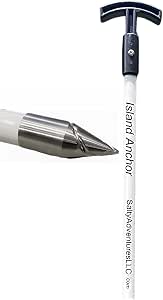 | Best for Pontoons and Big Boats | Dimensions: 1 in diameter x 8 ft (94 in nominal) | Shaft Material: Solid fiberglass (not hollow) | Tip: 316 stainless Turbo-Tip, 1.06 in diameter, grooved helix | VIEW ON AMAZON | See Our Full Breakdown |
| Lewmar Vector 6′ Manual Shallow Water Anchor, Pull Rope, Black, 69600961 |  | Best Manual Pick for Small Boats | Length: 6 ft | Deployment: Manual pull rope | Spike Material: Fiberglass | VIEW ON AMAZON | See Our Full Breakdown |
| Minn Kota Talon Shallow Water Anchor for Fishing Boats – 10 Ft., Black/Black |  | Best Premium Power Anchor | Spike Length: 10 ft | Operation: Electro-mechanical, sequential vertical deployment | Control Options: Wireless remote, foot switch (optional), smartphone app, select Humminbird units | VIEW ON AMAZON | See Our Full Breakdown |
| BeneLabel 17″ Screw-in Sand Anchor with 304 Stainless Steel Auger and 32ft Rope |  | Best Budget Portable Anchor | Length: 17 in (430 mm) | Material: 304 stainless steel | Weight: 1.28 lb (0.58 kg) | VIEW ON AMAZON | See Our Full Breakdown |
| salipref 20″ Carbon Fiber Boat Sand Anchor with T-Handle and Nylon Glass Fiber Auger, Green |  | Best Lightweight Beach Anchor | Length: 20 in | Tube Material: Carbon fiber | Auger Material: Nylon glass fiber | VIEW ON AMAZON | See Our Full Breakdown |
| Lewmar Vector 8′ Manual Shallow Water Anchor, Pull Rope, Black, 69600948 |  | Best Manual Anchor for Deeper Flats | Length: 8 ft | Deployment: Manual pull rope with elastic securing strap | Spike Material: Fiberglass | VIEW ON AMAZON | See Our Full Breakdown |
| SandShark Anchor – Premium Screw in Boat Anchor (Ultimate XL) |  | Best for Pontoon and Beach Sandbar Days | Anchor Type: Screw-in auger | Boat Capacity: Up to 30 feet | Material: Marine-grade metal construction | VIEW ON AMAZON | See Our Full Breakdown |
| SandShark SuperSport 3.0 Shallow Water Anchor |  | Best for Jet Skis and Small Craft | Anchor Type: Telescoping screw-in auger | Boat Capacity: Up to 24 feet, plus jet skis | Adjustable Length: 29 to 48 inches | VIEW ON AMAZON | See Our Full Breakdown |
| Power-Pole Sportsman II, 8ft., Black |  | Best Premium Power Anchor | Anchor Type: Powered shallow water anchor (hydraulic/electric deployment) | Length: 8 feet | Color: Black | VIEW ON AMAZON | See Our Full Breakdown |
More Details on Our Top Picks
Lewmar Axis 8′ Electric Shallow Water Anchor with Remote, Black, 69600944
Among the power-driven options here, this model stands out for skipping hydraulics entirely — the electric linear actuator means no pumps, no hoses, and no fluid to leak into the bilge. Compared with the Minn Kota Talon or Power-Pole Sportsman II, the install is refreshingly simple: bolt it to the transom, wire in the control box, and the RF remote does the rest from anywhere on the boat. The quiet 12V deployment matters more than it sounds when you’re holding position over spooky fish in skinny water. The tradeoff is real, though — this sits at the premium end of the roundup, an 8-foot reach limits deeper flats work, and it demands clean battery power and wiring discipline that manual poles like the Lewmar Vector never ask for.
Pros:- No hydraulic pumps or hoses to install, leak, or maintain
- RF remote operation lets you anchor from anywhere aboard
- Quiet 12V electric actuator won’t spook fish on deployment
- Complete kit includes mount hardware, control box, fuse holder and remote
Cons:- Premium price territory compared with every manual pole in this roundup
- Requires permanent transom mounting and boat wiring
- 8-foot reach limits use in water deeper than typical flat-boat depths
Best for: Anglers with bass-boat-style rigs who want push-button anchoring without hydraulic complexity
Not ideal for: Kayakers, small-craft owners, or anyone unwilling to run wiring and maintain a 12V system
- Length:8 ft
- Power:12V electric linear actuator
- Construction:Powder-coated aluminum
- Control:RF remote with control box
- Mounting:Transom mount
- Included:Mount hardware, RF module, auto-resetting fuse, waterproof fuse holder
- Noise Level:Low (electric drive)
Our verdict“This is the pick for boaters who want push-button shallow water holding and are willing to pay and wire for it.”
AugFir 8-FT Shallow Water Anchor, Portable Stainless Boat Anchor Pole, Quick-Lock with T-Handle
Where most poles in this roundup blend fiberglass shafts with metal tips, this one goes full stainless steel — shaft and T-handle alike — which is why it shrugs off saltwater seasons that would chalk up a fiberglass unit like the SuperStick pin. The two-section snap-button design breaks down for storage, something neither the SuperStick nor the Island Anchor offers, and the included bag plus tip cover makes it genuinely car-boat friendly. That triple-helix tip bites hard into packed sand and clay with minimal twisting effort. The catch: stainless is heavier on the arm than fiberglass rivals, there’s no way to cut it down to a custom length like the SuperStick’s adjustable design, and a full-metal pole transmits more shock to your hands when driving into hard bottom.
Pros:- Full stainless construction resists corrosion better than fiberglass or partial-steel poles
- Two-stage quick-lock design breaks down for compact storage and transport
- Triple-helix tip screws into sand and clay with less physical strain
- Includes durable storage bag and safety tip cover
Cons:- Heavier to handle than fiberglass poles like the itayak or SuperStick
- Cannot be cut down or customized like adjustable anchor pins
- Metal shaft transmits more vibration and shock during hard driving
Best for: Saltwater and brackish anglers who want a rust-proof pole they can stow in pieces
Not ideal for: Weight-conscious kayakers or anyone who wants to trim their pole to a custom fixed length
- Total Length:9.8 ft (8-ft practical anchor reach)
- Construction:Full stainless steel shaft and handle
- Design:2-stage quick-lock, snap-button assembly
- Tip:3-segment sharp spiral helix
- Handle:Stainless T-handle
- Included:Storage bag and protective tip cover
- Bottom Types:Sand, clay
Our verdict“Buy this if saltwater durability and pack-down portability top your list; skip it if weight savings matter more than rust resistance.”
itayak 8.63’/12.3′ Shallow Water Anchor Pole with T-Handle, Fiberglass Reinforced Polyamide66
This option makes the most sense for buyers who want the lightweight, rust-free feel of fiberglass without paying stainless prices. The fiberglass-reinforced Polyamide66 shaft keeps weight down noticeably compared with the all-steel AugFir, and the 316 stainless tip still gives it credible bite in sand and clay — the same tip material as the pricier Island Anchor. The nylon T-handle is comfortable for twisting into firm bottom, and it comes in two length options so kayakers and small-boaters can match their water depth. Tradeoffs are the flip side of the price: fiberglass can shed splinters at cut or damaged spots (gloves are included for a reason), it lacks the AugFir’s breakdown storage design, and the screw-together sections aren’t as rock-solid as a one-piece pole under heavy lateral load.
Pros:- Lightweight fiberglass shaft is easier to handle than stainless poles
- 316 stainless tip matches the corrosion resistance of premium rivals
- Available in two lengths to match kayak or boat usage
- Comfortable, durable nylon T-handle reduces twisting effort (gloves included)
Cons:- Fiberglass can produce splinters at cut or damaged areas
- Multi-section connection flexes more under load than one-piece poles
- No storage bag or breakdown design for transport
Best for: Kayak and small-boat anglers who want an affordable, lightweight, rust-proof anchor pole
Not ideal for: Boaters who need one-piece rigidity under heavy load or compact two-piece storage
- Length Options:8.63 ft / 12.3 ft
- Shaft Material:Fiberglass-reinforced Polyamide66
- Tip Material:316 stainless steel
- Handle:Nylon (PA66) T-handle
- Connecting Parts:High-strength carbon fiber
- Best Use:Kayaks, small boats, shallow flats
- Included:Protective gloves
Our verdict“A sensible low-cost entry into shallow water anchoring for light craft, as long as you accept some flex and handle it with the included gloves.”
SuperStick Shallow Water Anchor Pin, 3/4″ x 8′, Black
Sometimes the simplest tool wins, and this aircraft-grade fiberglass pin proves it. Unlike the itayak’s multi-section build, this is a one-piece shaft — no joints to flex or loosen — with a stainless spike tip that resists the wear and splintering that plague bare fiberglass ends. The genuinely clever trick is the removable T-handle: unscrew it, cut the pole to whatever fixed length suits your boat, and reattach. Neither the AugFir nor the Island Anchor offers that kind of customization. At roughly five pounds it’s easy to stash alongside a push pole. The compromises are plain, though — no helix or auger tip means it relies on friction rather than screw-in grip in current or wind, and there’s no bag, cover, or mounting hardware included, so storage and deployment are entirely DIY.
Pros:- One-piece aircraft-grade fiberglass shaft with UV inhibitor won’t flex at joints
- Stainless spike tip resists wear and splintering at the business end
- Removable T-handle lets you cut the pole to a custom fixed length
- Lightweight at about 5 pounds for easy stowage
Cons:- No helical auger tip, so holding power in wind or current trails screw-in designs
- No storage bag, cover, or mounting accessories included
- Fixed 8-foot length requires cutting if you want it shorter
Best for: Flats anglers and poling-skiff owners who want a cut-to-fit, one-piece pin at a modest price
Not ideal for: Boaters who regularly fight wind or current and need a screw-in auger grip
- Dimensions:3/4 in x 8 ft (96 in)
- Weight:5 lb
- Shaft Material:Aircraft-grade fiberglass with UV inhibitor
- Tip:Stainless steel spike
- Handle:Removable T-handle (stainless screw attach)
- Customization:Can be cut to desired fixed length
- Color:Black
Our verdict“The smart buy for anglers who value simplicity and custom fit over maximum holding power.”
Island Anchor – 1″ x 8′ Shallow Water Anchor Pole for Larger Boats
Most poles in this roundup quietly assume a flats skiff or kayak underneath you; this one doesn’t. The 1-inch solid fiberglass shaft — not hollow, not aluminum — is built for the lateral loads a 23- to 35-foot boat or a pontoon puts on an anchor pin, where the 3/4-inch SuperStick would flex past its comfort zone. The Turbo-Tip’s grooved 316 stainless helix screws into hard-packed sand and clay the way the AugFir’s triple-helix does, but on a shaft with real backbone behind it. That stiffness is also the drawback: it’s heavier and bulkier to swing and stow than slim pins, it’s overkill (and over-arm-strain) for a kayak or jon boat, and like the SuperStick it ships without a storage bag or mounting kit.
Pros:- 1-inch solid fiberglass shaft handles the loads of boats up to 35 feet
- 316 stainless Turbo-Tip helix screws into hard-packed sand and clay
- Stiff-yet-flexible formulation resists cracking, breaking, and snapping
- Explicitly rated for pontoons and tritoons, unlike most pins here
Cons:- Heavier and more cumbersome to deploy than 3/4-inch fiberglass pins
- No storage bag, cover, or mounting hardware included
- 8-foot fixed length with no cut-down or breakdown option
Best for: Pontoon, tritoon, and 23–35 ft boat owners who anchor at sandbars and beaches
Not ideal for: Kayak and small-boat anglers — the 1-inch shaft is heavier and stiffer than they need
- Dimensions:1 in diameter x 8 ft (94 in nominal)
- Shaft Material:Solid fiberglass (not hollow)
- Tip:316 stainless Turbo-Tip, 1.06 in diameter, grooved helix
- Recommended Boat Size:23–35 ft, plus all pontoons and tritoons
- Bottom Types:Hard-packed sand, clay
- Corrosion Resistance:No rust, no staining
- Design:Stiff yet flexible to resist breaking
Our verdict“If a pontoon or bigger boat hangs off your anchor, this is the pole with the shaft to match — everyone smaller should shop the lighter options.”
Lewmar Vector 6′ Manual Shallow Water Anchor, Pull Rope, Black, 69600961
The 6-foot Lewmar Vector manual makes the most sense for anglers who want Power-Pole-style anchoring without the wiring, pumps, or hydraulic hoses that powered systems demand. Deployment is a pull-rope affair: release the elastic strap, let the fiberglass spike descend, and the gas spring locks it against the bottom even when wake turbulence tries to shove the boat sideways. Compared with the Minn Kota Talon, the tradeoff is obvious — you give up remote control and push-button convenience, but you also eliminate the electrical installation, the battery draw, and the maintenance that comes with electro-mechanical units. Its universal hole patterns also mean it fits many aftermarket mounts already drilled for competitors. The catch is the boat rating: at 22 feet or 3,000 pounds, it taps out where the Talon and Power-Pole Sportsman II keep working, and the 6-foot spike limits you to genuinely shallow flats.
Pros:- No pumps, hoses, or wiring — installation and maintenance stay simple
- Gas-spring-secured fiberglass spike holds firm through wake turbulence
- Universal hole pattern works with many aftermarket mounts
- Powder-coated aluminum body handles saltwater exposure
Cons:- Manual pull-rope retrieval requires leaning over the transom every time
- Limited to boats up to 22 feet or 3,000 pounds — the lowest capacity of the boat-mounted picks
Best for: Owners of skiffs and bay boats under 22 feet who want spike-style holding power without installing electrical gear
Not ideal for: Boats over 22 feet or anglers who fish deeper water — the spike length and boat rating both run out quickly
- Length:6 ft
- Deployment:Manual pull rope
- Spike Material:Fiberglass
- Retention System:Gas spring
- Body Material:Powder-coated aluminum
- Wiring Required:None
- Color:Black
Our verdict“This is the pick for small-boat owners who want to skip the wiring harness entirely and still get spike-driven holding power in skinny water.”
Minn Kota Talon Shallow Water Anchor for Fishing Boats – 10 Ft., Black/Black
The Minn Kota Talon 10-footer sits at the deep end of this roundup in both reach and capability. Its 10-foot spike means you can anchor in water where the 6-foot Lewmar Vector simply can’t touch bottom, and its sequential vertical deployment is quieter than most competitors — a real advantage when fish are skittish. What separates it from every manual option here is control: a wireless remote, an optional foot switch, a smartphone app, and even select Humminbird units can drop the spike from anywhere on the boat. The user-selectable anchoring modes (normal, rough water, soft bottom) let you tune behavior to conditions, something a pull-rope anchor like the Lewmar Vector can never do. The tradeoffs are weight on the transom, full electrical installation, and a price tier that makes the manual Vector look like a bargain. You pay for automation, and not every boater needs it.
Pros:- 10-foot reach anchors in deeper water than shorter spikes can reach
- Remote, foot switch, app, and Humminbird integration for control anywhere on board
- User-selectable modes for rough water and soft bottoms
- Five-year limited warranty with lifetime spike coverage
Cons:- Requires full electrical installation, unlike manual pull-rope anchors
- Substantially more expensive than manual and portable alternatives
- Adds meaningful weight and complexity to the transom
Best for: Serious tournament anglers and saltwater fishermen who need maximum reach, quiet deployment, and remote operation from anywhere on the boat
Not ideal for: Budget-conscious buyers or small kayaks and jet skis — it’s a heavy electro-mechanical unit built for fishing boats with proper transom space and battery power
- Spike Length:10 ft
- Operation:Electro-mechanical, sequential vertical deployment
- Control Options:Wireless remote, foot switch (optional), smartphone app, select Humminbird units
- Anchoring Modes:Normal, rough water, soft bottom
- Work Light:Blue or white, three brightness levels
- Weight:14 lb (shipping unit)
- Warranty:5-year limited; lifetime spike
- Color:Black/Black
Our verdict“If push-button anchoring from the bow and deep-water reach matter more than budget, the Talon is the most capable powered option in this lineup.”
BeneLabel 17″ Screw-in Sand Anchor with 304 Stainless Steel Auger and 32ft Rope
Not everyone needs a boat-mounted spike, and the BeneLabel screw-in sand anchor is the affordable, stowable answer for beach and sandbar days. The 304 stainless steel auger twists into the sand by hand with a removable T-handle, and the kit arrives complete with a 32-foot rope, float ball, and hook — no extras to buy. At 1.28 pounds, it disappears into a storage compartment in a way no pole system can match; even the lightweight carbon-fiber salipref auger needs more stowage thought. Compared with the Lewmar Vector, you sacrifice instant, on-boat deployment — this anchor is something you set from the beach or by wading out, not something you drop from the helm mid-drift. Holding power is genuinely decent in packed sand thanks to the helical design, but a 17-inch auger is a sandbar tool, not a rough-water solution, and it’s slow to deploy repeatedly.
Pros:- Complete kit includes rope, float, hook, and T-handle
- 304 stainless construction resists saltwater corrosion
- Ultra-light at 1.28 lb and small enough to stow anywhere
- Helical tip grips soft and hard sand reliably
Cons:- Manual screw-in deployment requires wading or beach access each time
- Limited holding power for larger boats or choppy conditions
Best for: Kayakers, jet ski riders, and sandbar-day boaters who want a cheap, pocketable anchor for occasional beach stops
Not ideal for: Anglers who need to reposition frequently or hold in current and chop — hand-screwing an auger between every drift is impractical
- Length:17 in (430 mm)
- Material:304 stainless steel
- Weight:1.28 lb (0.58 kg)
- Included Rope:32 ft with float ball and hook
- Handle:Removable T-handle
- Suitable Craft:Kayaks, canoes, jet skis, pontoon and small motorboats
- Available Sizes:17″, 26″, 36″
Our verdict“For casual beach and sandbar anchoring on small craft, this is the easiest and cheapest way to stop drifting without bolting anything to the boat.”
salipref 20″ Carbon Fiber Boat Sand Anchor with T-Handle and Nylon Glass Fiber Auger, Green
The salipref 20-inch sand anchor splits the difference between the tiny BeneLabel auger and full pole systems. Its carbon fiber tube with a nylon glass fiber auger keeps weight to a minimum while resisting saltwater corrosion better than bare steel, and the ergonomic T-handle with progressive screw design makes seating it in sand, clay, or silt noticeably less of a workout. The bright green handle plus an orange float means you can spot your anchor point from a distance — a small touch the BeneLabel kit doesn’t emphasize. Compared with the stainless BeneLabel, this one prioritizes scratch-free handling and visibility; compared with the itayak or Island Anchor poles, it trades holding power and length for a storage bag, mounting hardware, and true portability. That’s the real tradeoff: rated for boats under 23 feet on paper, but a 20-inch auger is best treated as a kayak, jet ski, and small-craft beach tool rather than a fishing platform anchor.
Pros:- Carbon fiber and nylon glass fiber build won’t rust or scratch gelcoat
- Ergonomic T-handle and progressive screw ease penetration in mixed bottoms
- High-visibility green handle and orange float make anchor points easy to spot
- Full accessory package includes rope, float, storage bag, tools, and mounting screws
Cons:- 20-inch auger offers limited holding power in wind or current
- Composite construction is less rugged than solid stainless augers in rocky conditions
Best for: Kayak and jet ski owners who want a corrosion-free, visibility-focused beach anchor that packs into a storage bag
Not ideal for: Anglers holding boats on open flats — it lacks the length and bite of pole-style anchors like the Lewmar Vector
- Length:20 in
- Tube Material:Carbon fiber
- Auger Material:Nylon glass fiber
- Handle:PA66 + 30% glass fiber T-handle
- Holding Method:Triple-layer sediment compression
- Included Items:Tube, auger, T-handle, 5 screws, 2 hex spanners, float with rope, storage bag
Our verdict“A smart pick for paddlers and PWC riders who value lightweight, rust-free materials and don’t need the holding power of a boat-mounted pole.”
Lewmar Vector 8′ Manual Shallow Water Anchor, Pull Rope, Black, 69600948
Think of the 8-foot Lewmar Vector as the 6-footer’s bigger sibling for water that’s a little too deep for the shorter spike. Same gas-spring fiberglass spike, same zero-wiring pull-rope operation, same universal mounting patterns — but with two extra feet of reach that matter on drop-offs, grass edges, and flats where the bottom sits farther down. Against the Minn Kota Talon, it concedes remote operation and anchoring modes but wins on simplicity: no battery drain, no harness to run, nothing to fail electrically. The white powder-coated finish also runs cooler in the sun than darker units, a small comfort during summer retrieval. The honest drawbacks are unchanged from the manual formula — you still bend over the transom to pull the retrieval strap, and the extra length requires more freeboard clearance when the boat is loaded heavy or trimming bow-down.
Pros:- 8-foot spike extends usable depth beyond the 6-foot model
- Gas spring keeps the spike planted through wake turbulence
- No wiring, pumps, or hoses — mounts using universal hole patterns
- White powder-coated aluminum finish resists corrosion and stays cooler in sun
Cons:- Manual retrieval strap demands physical effort at every stop
- The 8-foot length requires adequate transom freeboard and careful stowage
Best for: Flats anglers in the 22-to-28-foot boat range or those fishing 6-plus feet of water who want spike anchoring without any electrical install
Not ideal for: Anyone wanting hands-free push-button deployment — the manual strap routine gets old fast on boats that reposition constantly
- Length:8 ft
- Deployment:Manual pull rope with elastic securing strap
- Spike Material:Fiberglass
- Retention System:Gas spring
- Body Material:Powder-coated aluminum
- Wiring Required:None
- Mounting:Universal hole patterns, aftermarket-mount compatible
- Color:White
Our verdict“The right manual choice when your fishing water is just deep enough that a 6-foot spike comes up short but powered anchors feel like overkill.”
SandShark Anchor – Premium Screw in Boat Anchor (Ultimate XL)
The SandShark Ultimate XL stands out among screw-in auger anchors for one reason: it is built specifically around the sandbar and beach scenario that pontoon and tritoon owners live for. Unlike the pole-style options in this roundup, such as the Island Anchor 8-foot pin, the auger design twists into the sand and relies on suction rather than friction, which translates to far better holding power in soft sand where a plain pole can slowly work itself loose. Rated for boats up to 30 feet, it carries more capacity than the SandShark SuperSport 3.0, making it the stronger pick for bigger deck boats.
The tradeoff is effort and reach. There is no telescoping handle, so setting it means getting wet, and retrieving a deeply suctioned auger from saturated sand takes real torque — something lighter anchors like the BeneLabel sand anchor sidestep with their smaller spiral profiles. The included case helps with storage, but at roughly 12 pounds it is a commitment to carry.
Pros:- Auger suction design delivers holding power that friction-based poles can’t match in soft sand
- Rated for boats up to 30 feet, the highest capacity of the screw-in anchors here
- Marine-grade corrosion-resistant construction for season after season of saltwater use
- Includes a storage case, which most competing anchor pins omit
Cons:- No telescoping or leverage assistance — setting and retrieving requires manual cranking and getting in the water
- Heavier and bulkier than telescoping alternatives like the SuperSport 3.0
- Auger design is far less effective on rock or hard-packed bottoms
Best for: Pontoon, tritoon, and deck boat owners up to 30 feet who regularly beach at sandbars and want maximum suction holding in soft sand
Not ideal for: Kayak and jet ski owners — it is heavier and longer than needed, and the SuperSport 3.0 covers small craft far better
- Anchor Type:Screw-in auger
- Boat Capacity:Up to 30 feet
- Material:Marine-grade metal construction
- Length:39 inches
- Weight:Approx. 12.3 lbs (5.56 kg package)
- Best Bottom Type:Sand, mud, gravel, clay
- Included:Storage case
Our verdict“If your typical day ends beached on a sandbar with a 24- to 30-foot pontoon, this is the suction power you want — smaller craft and casual users should look at lighter options.”
SandShark SuperSport 3.0 Shallow Water Anchor
Where the Ultimate XL is built for big pontoons, the SuperSport 3.0 is the version aimed at the other end of the spectrum: jet skis, PWCs, small boats to 24 feet, and kayakers who want real holding power without hauling a full-size pole. Its defining feature is the telescoping 29-to-48-inch range, which no fixed-length pin in this roundup — including the Shallow Water Anchor Pin 3/4″ x 8′ — can match. That adjustability means one anchor handles both a knee-deep beach landing and slightly deeper anchoring without swapping gear.
At around five pounds, setup is genuinely a one-person job: twist it in 12 to 18 inches, clip a bungee, and you’re done. The compromise is raw holding capacity. The aluminum-and-nylon build keeps weight down but gives up the sheer beef of the Ultimate XL, and in choppy conditions with a heavier boat it flexes where a solid fiberglass pole like the itayak would not. The telescoping mechanism is also one more thing that can jam with sand if not rinsed.
Pros:- Telescopes from 29 to 48 inches to match varying water depths with one anchor
- Lightweight design makes solo setup possible in under 30 seconds
- Corrosion-resistant aluminum and nylon construction for saltwater and freshwater use
- Collapses down compactly and includes a case for stowage on a jet ski or small boat
Cons:- Lower holding capacity than fixed full-size poles and the Ultimate XL auger
- Telescoping sections can bind if sand is not rinsed out after beach use
- Nylon components are less rugged than solid fiberglass or stainless equivalents
Best for: Jet ski and PWC riders, plus small-boat owners under 24 feet who want an adjustable, featherweight anchor they can set solo in under a minute
Not ideal for: Owners of boats over 24 feet or anyone anchoring in rough conditions — the lightweight build lacks the holding authority of larger augers and fixed poles
- Anchor Type:Telescoping screw-in auger
- Boat Capacity:Up to 24 feet, plus jet skis
- Adjustable Length:29 to 48 inches
- Weight:Approx. 5 lbs (1.68 kg)
- Material:Marine-grade aluminum and high-strength nylon
- Water Types:Saltwater and freshwater
- Included:Storage case
Our verdict“For PWC and small-boat riders who value portability and depth flexibility over maximum holding power, this is the easiest anchor in the lineup to live with.”
Power-Pole Sportsman II, 8ft., Black
The Power-Pole Sportsman II plays an entirely different game from every manual option here. Where the SandShark Ultimate XL or the Minn Kota Talon alternatives demand you step into the water and muscle an anchor down, the Sportsman II deploys at the push of a button from the helm, locking your boat in place in seconds without ever leaving the console. For angller who work wind-blown shorelines and reposition constantly, that speed is the whole point — the difference between fishing a spot and watching it drift away while you re-set a manual pole.
The eight-foot reach covers most flats fishing depths, and the extremely quiet pump matters more than it sounds when you are positioned over spooky fish in inches of water. Drive-off protection and a powder-coated finish round out a system built for daily hard use. But this is a permanently mounted, pump-driven system: it requires professional-grade installation, a battery connection, and a boat with a suitable transom. Casual sandbar families will find it wildly overengineered compared with a $100 manual pin, and the 8-foot fixed length limits you in slightly deeper water compared with the 10-foot Minn Kota Talon.
Pros:- Push-button deployment from the boat — no wading, no manual cranking
- Whisper-quiet pump operation that won’t spook fish in shallow water
- Drive-off protection prevents damage if you motor away with the pole down
- Durable powder-coated finish engineered for years of hard freshwater and saltwater use
Cons:- Requires permanent mounting, a power source, and involved installation
- 8-foot fixed reach is outclassed in deeper water by the 10-foot Minn Kota Talon
- Far more expensive and complex than any manual pole or auger in this roundup
Best for: Serious flats and bass anglers who reposition frequently and want push-button anchoring without ever getting wet
Not ideal for: Casual beach-day boaters and anyone without a compatible transom or budget for professional installation — a manual pole covers the same ground for a fraction of the complexity
- Anchor Type:Powered shallow water anchor (hydraulic/electric deployment)
- Length:8 feet
- Color:Black
- Finish:Powder coated
- Deployment:Down and away deployment with remote operation
- Special Features:Quiet pump, drive-off protection
- Mounting:Permanent transom mount required
Our verdict“This is the pick for anglers who anchor dozens of times a day and want it done instantly and silently — everyone else should save the money and complexity and go manual.”

How We Picked
I ranked these systems on five factors that actually decide whether an anchor works on the water: holding power across bottom types (mud, sand, grass, rock), deployment speed and effort, build durability under saltwater exposure, mounting and transport requirements, and value relative to what the system replaces. Powered anchors were judged against a higher standard because their price demands it — a Talon that can’t hold in current or a Power-Pole with fragile components would fail the value test even with flawless performance in calm conditions.
The ranking logic follows buyer fit rather than raw capability. Powered transom-mount systems sit at the top because they solve the core problem — repositioning a boat quietly while fishing — better than anything manual. Manual poles rank next, ordered by material quality and length, since fiberglass and stainless constructions hold where budget plastic fails. Screw-in sand anchors rank separately because they serve a different job entirely: stationary beach and sandbar anchoring rather than fishing repositioning. I penalized systems for narrow bottom compatibility, short reach that limits usable water depth, and any design that requires two people or extra tools to deploy.
Factors to Consider When Choosing Shallow Water Anchor Systems
Before spending money on any shallow water anchor system, you need to match the tool to your boat, your bottom conditions, and how you actually spend time on the water. These are the factors that separate a system you use every trip from one that gathers dust in a storage compartment.Pole, Power, or Screw — Which Family Fits Your Boating
The most common mistake buyers make is treating all shallow water anchors as interchangeable. Powered poles like the Talon and Power-Pole are fishing tools — they let you reposition a boat silently in seconds, which matters when you’re working a shoreline or holding on a spot while wind pushes you around. Manual poles and pins do the same job with sweat equity, making them sensible for kayaks, jon boats, and anglers who reposition a few times per day rather than constantly. Screw-in sand anchors serve an entirely different purpose: parking a boat or PWC at a beach or sandbar for hours. Buying a sand screw expecting fishing performance, or buying a $2,000 power pole for occasional sandbar stops, wastes money in both directions. Start by honest about which activity dominates your time on the water.
Water Depth and Pole Length
Pole length dictates where you can anchor, and buyers consistently overestimate how much reach they need to lose. A usable rule: the pole should extend at least two feet below the hull in typical conditions, meaning an 8-foot pole realistically handles about 4 to 5 feet of water depth on most boats. Wave action eats into that margin fast — a boat rocking through 18-inch chop can pop a short pole free even in water it nominally covers. The 10-foot Talon earns its premium partly because it covers depths where 6- and 8-foot models simply let go. At the other extreme, longer manual poles become awkward to store and harder to drive into hard bottom by hand, which is why kayak anglers often prefer 8 feet over 12. Match length to the water you actually fish, not the deepest hole you might someday visit.
Bottom Type Compatibility
No anchor holds in everything, and bottom composition is where cheap systems fail publicly. Screw-in augers excel in packed sand but are nearly useless in mud, grass, or rock — the threads can’t bite into anything they can’t cut into. Solid poles work in mud and sand but can glance off rock or struggle to penetrate hard clay, especially manual models without a sharp tip. Fiberglass and stainless constructions drive into firmer bottom than plastic pins, which flex and bounce under load. If your local water mixes bottom types, favor a pole system over a screw anchor, and look for hardened tips. Pontoon owners on sandy lakes are the exception — a quality sand screw will outperform any pole for stationary beach anchoring in that environment.
Mounting, Storage, and Transport
Powered systems demand real installation: transom or jack-plate mounting, battery connection, and often a dedicated circuit — factor in that hardware and labor before comparing prices against a manual pole. Check your transom space early, because some bass and bay boats have trim tabs, transducers, or kickers that conflict with anchor mounting brackets. Manual poles trade that complexity for storage burden; an 8-foot pole needs a home on deck or under a gunnel, and models that include storage bags and covers protect both the pole and your gelcoat during transport. Kayak anglers should weigh pole diameter and weight carefully since everything rides with you. The compact screw-in anchors are the easiest to stow but the most limited in function, so their convenience only pays off if sandbar stops are your actual use case.
Corrosion Resistance and Long-Term Maintenance
Saltwater destroys cheap anchors, and it does so from the hardware inward — not the pole itself. Look for 316 or 304 stainless steel components, sealed electronics, and replaceable wear parts when comparing builds, because the fasteners, rope locks, and mounting brackets corrode long before the main shaft gives out. Powered systems add a maintenance layer manual anchors never face: electrical connections to inspect, remotes to battery-manage, and hydraulic or drive mechanisms that need rinsing after saltwater use. Manual poles ask almost nothing beyond a freshwater rinse, which is a genuine advantage for occasional users who won’t perform upkeep. Rinsing everything after saltwater trips costs nothing and extends lifespan across every system in this category, powered or not.
When Paying More Actually Pays
The jump from a manual pole to a powered system is the single biggest price decision in this category, and it only makes sense under specific conditions. Pay up if you reposition constantly while fishing, fish tournaments where seconds matter, or regularly fish alone in wind where hand-deploying a pole is impractical. Skip the upgrade if you anchor a handful of times per trip, fish with a partner who can handle a manual pole, or primarily beach your boat — a powered pole solves a problem you don’t have. Within manual options, spending more buys better materials (fiberglass over plastic, stainless over coated steel) and better tip design, and that spending usually pays off in holding power and lifespan. Within screw anchors, spending more buys stainless construction and better handles, which matters most for saltwater users.
Frequently Asked Questions
Can a manual shallow water pole actually replace a Power-Pole or Talon?
For many anglers, yes — but only if you’re honest about how you fish. A manual pole like the itayak or Island Anchor holds the same bottom and resists the same current as a powered anchor; what it can’t do is deploy silently in three seconds while your hands stay on the rod. If you reposition five or six times per trip, the manual version costs you a few minutes of effort total, which most casual anglers tolerate fine. If you’re a tournament angler working a bank and repositioning every few casts, or you fish alone in wind where leaving the console isn’t practical, the powered system earns its price every single trip. The holding performance is comparable — the difference is entirely about deployment speed and convenience.
How deep can a shallow water anchor system actually work?
As a working rule, subtract about two to three feet from the pole’s length to find your realistic maximum water depth, since some pole stays above the waterline and your boat’s freeboard matters. An 8-foot pole typically handles 4 to 5 feet of calm water, while the 10-foot Talon pushes that closer to 6 or 7 feet on a low-freeboard boat. Wave action shrinks those numbers further — a boat rocking in chop needs extra buried length to stay pinned, and short poles pop free surprisingly fast in those conditions. If your usual water runs deeper than about 5 feet, either buy the longest system you can mount and store, or accept that a shallow water anchor is a supplement to your main anchor rather than a replacement. Deeper water is what traditional anchors and anchor trolleys are for.
Do sand screw anchors work in mud or grass, or only sand?
Sand screws are genuinely sand-specific tools, and this trips up a lot of buyers. The auger threads need to cut into packed sand to generate holding power; in soft mud they just spin without gripping, and in grass or rock they can’t penetrate at all. If your lake or bay has mixed bottom, a solid pole will outperform a screw anchor almost everywhere except the sandbar itself. The reverse is also true — on a firm sandbar where you’re parking the boat for hours while people swim, a good screw anchor like the SandShark holds more securely than a pole, which wave action and foot traffic can work loose. Know your bottom before choosing between these two designs, because neither covers the other’s ground well.
Are shallow water anchor systems practical for kayaks and small craft?
Yes, and in some ways they suit kayaks better than power boats, with a few caveats. A manual pole like the itayak or AugFir gives a kayak angler precise, quiet positioning that a traditional drag anchor can’t match, especially in wind on flats — the pole pins you exactly where you cast rather than swinging you on a rode. The tradeoffs are weight and length: an 8-foot pole needs secure deck storage, and a 12-footer is genuinely awkward on a small kayak, so match length to your craft. Diameter matters too, since a thin fiberglass pole is far easier to push into bottom from a seated position than a fat stainless one. Skip powered systems entirely on kayaks — the weight, mounting, and power requirements rule them out.
What does installing a powered anchor involve, and can I do it myself?
Plan on a half-day project with real electrical work involved, not a bolt-on accessory. You’ll need to mount the unit to your transom or jack plate (checking first for conflicts with trim tabs, transducers, or a kicker motor), run power to your battery with appropriate gauge wire and a fuse or breaker, and pair the remote. Boats with existing jack plates make mounting much easier, while flat transoms may require an adapter bracket sold separately. If you’re comfortable with basic wiring and drilling into your transom, it’s a manageable DIY job; if the thought of cutting holes below the waterline bothers you, professional installation is worth the cost. Manual poles and screw anchors obviously skip all of this, which is part of why they hold their value for occasional users.
Conclusion
The right choice here depends less on which system is best and more on how you spend your day on the water. Best overall goes to the Minn Kota Talon 10-foot for anglers who reposition constantly and want silent, push-button holding in the widest range of depths — with the Power-Pole Sportsman II as a near-equal alternative if you prefer its deployment style. Best premium honors go to the Lewmar Axis electric, which brings powered convenience to boats where a sleek integrated look matters. Best value is clearly the itayak fiberglass pole: it delivers roughly 80 percent of a powered anchor’s usefulness at a tiny fraction of the cost, and it’s the pick I’d point most casual anglers toward. Beginners and kayak anglers should start with the AugFir or the basic 8-foot anchor pin — cheap, simple, and enough to learn whether a pole fits your fishing before spending more. For specific needs, the SandShark handles pontoon sandbar stops, the adjustable Supersport 3.0 covers jet skis and PWCs, and the Island Anchor’s 1-inch diameter suits larger boats that overwhelm thinner manual pins. Whatever you choose, match the system to your bottom conditions and water depth first — that decision matters more than any brand name on the pole.
Halloween Picks
halloween
As an affiliate, we earn on qualifying purchases.