
TL;DR

Get pool and patio gear delivered free with Prime
- Fast, free delivery on millions of items
- Prime Video, Amazon Music and more included
- Member-only deals all year
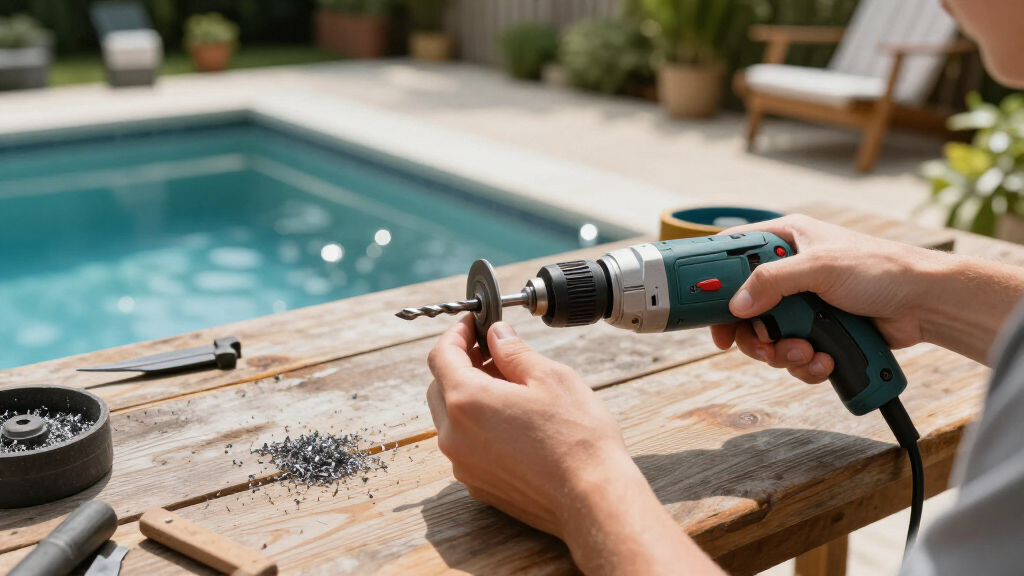
Hunker reports that a Dremel rotary tool can sharpen twist drill bits as an alternative to a bench grinder, provided the bit is secured and the cutting edges are ground carefully. The guide says to preserve the bit’s existing point geometry, remove only a small amount of metal and wear eye protection and gloves.
Hunker has published a guide showing how to sharpen twist drill bits with a Dremel rotary tool, offering a bench-grinder alternative for people who already own one. The method depends on securely clamping the bit, stabilizing the tool hand and carefully restoring both cutting edges; it is a practical how-to, not a report of new testing or a product announcement.
The guide advises clamping the drill bit in a vise with ¼ inch or less exposed, leaving the cutting end accessible while limiting movement. For freehand grinding, it says to hold the Dremel in one hand and brace that hand by grasping the wrist with the other, with the supporting hand resting on the vise. The tool should engage the cutting edge gently, following the angle already ground into the bit.
Hunker says to remove only a tiny amount of metal, keep the point centered and grind both cutting edges. It identifies 118 degrees as a common point angle for drilling wood, plastic and composite materials such as MDF and plywood, and 135 degrees as most common for metal. The guide says exact angles are not required, but recommends approximating the original geometry.
For people who do not want to guide the tool entirely by hand, the article describes aftermarket jigs and attachments that hold or guide the bit and grinder to make the process more controlled. It says some accessories set the grinding angle, and that some versions can be 3D-printed. Hunker notes that Dremel does not appear to offer an attachment specifically for this task, while saying the company sells a separate dedicated machine.
A Rotary Tool as a Grinder Alternative
The approach could let a DIY user sharpen a worn twist bit without buying or setting up a bench grinder, if a Dremel and suitable grinding accessory are already available. Keeping usable bits sharp can help avoid replacing them as soon, although the source does not quantify cost savings, sharpening time or performance.
The method also calls for care: a drill bit’s point and cutting edges need to remain aligned, and the article stresses that freehand grinding requires a stable setup. A jig may help control the angle, but the source does not compare particular attachments or establish that every accessory will suit every bit. Readers should treat the instructions as general guidance rather than a guarantee of a particular result.
Dremel rotary tool for sharpening drill bits
As an affiliate, we earn on qualifying purchases.
As an affiliate, we earn on qualifying purchases.
Angles and Setup for Twist Bits
The article addresses twist drill bits, not every kind of drill bit. Its angle guidance distinguishes common points for different materials: 118 degrees for wood, plastic and composites, and 135 degrees for metal. Those figures are presented as typical angles, not as a requirement to measure every bit precisely before sharpening.
Hunker’s described process is a freehand method, with the vise serving both to secure the bit and to provide a brace for the operator’s supporting hand. The publication also points to jigs as an alternative way to manage alignment. The source does not provide independent test results, detailed instructions for selecting a Dremel grinding accessory, or recommendations for specific bit sizes and materials.
““Remove a tiny amount of the metal, keeping the point of the twist bit in the center.””
— Hunker
Limits of the Freehand Method
The source does not report tests comparing Dremel sharpening with a bench grinder, nor does it establish how long the process takes or how much longer a sharpened bit will last. It also does not specify which grinding attachment is appropriate for each bit or Dremel model. Its statement that the method can sharpen bits in seconds is the article’s characterization, not a measured result.
Hunker does not give detailed guidance for badly damaged bits, specialized drill-bit geometries or the amount of pressure to apply. The advice is specifically about twist bits, and the article’s general safety reminder does not replace the instructions for a particular rotary tool or accessory.
Check the Tool and Bit Instructions
Anyone considering the method should first confirm that the bit is a twist bit and that the chosen Dremel accessory is suitable for grinding it. Secure the bit before starting, wear eye protection and protective gloves as Hunker advises, and follow the tool and accessory manufacturers’ safety instructions. If using an aftermarket jig, check its instructions for compatible bit sizes and angles.
The source provides no announced follow-up, product release or additional testing. Further practical details—such as comparisons between jigs or guidance for specific bit types—would need to come from the relevant tool and accessory makers or from additional reporting.
Key Questions
Can a Dremel sharpen twist drill bits?
Hunker says a Dremel rotary tool can be used to sharpen twist bits. Its method requires securing the bit and carefully grinding both cutting edges.
What angles does the guide recommend?
The article describes 118 degrees as common for wood, plastic and composite materials, and 135 degrees as most common for metal. It recommends approximating the bit’s existing angle rather than requiring exact measurement.
How should the bit be secured?
Hunker advises clamping it in a vise with ¼ inch or less exposed, so the cutting end remains accessible while the bit is held steady.
Are special attachments available?
The article says aftermarket jigs can guide the bit or tool and make grinding more controlled. It does not assess particular products or confirm compatibility with every Dremel model.
What safety precautions does the article mention?
Hunker advises wearing protective gloves and eye protection. Users should also follow the instructions for their rotary tool and grinding accessory.
Source: rss
Halloween Picks
halloween
As an affiliate, we earn on qualifying purchases.