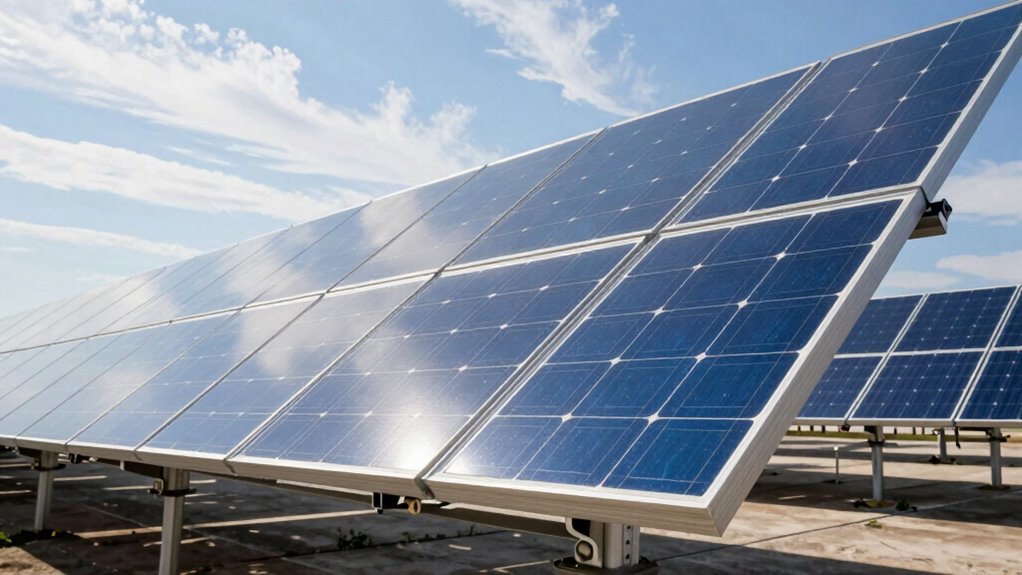

To boost your solar generator’s charge speed, set your panels at the ideal angle facing direct sunlight, usually close to your latitude. Adjust the tilt seasonally for maximum efficiency — steeper in winter, flatter in summer. Use tools like inclinometers to get precise angles and clear any shading or debris. Avoid sticking to a fixed position in areas with significant seasonal changes. Keep learning tips to guarantee your setup consistently maximizes solar absorption.

Get pool and patio gear delivered free — and shop member deals
- Fast, free delivery on millions of items
- Access to Prime Big Deal Days deals on October 6–7
- Prime Video, Amazon Music and more included
Key Takeaways
- Orient panels toward true south (Northern Hemisphere) or true north (Southern Hemisphere) for optimal sunlight exposure.
- Set fixed panel angles close to your latitude for consistent year-round charging efficiency.
- Adjust panel tilt seasonally to follow the sun’s path and maximize charge speed.
- Use tools like inclinometers or smartphone apps to accurately measure and set panel angles.
- Regularly check for shading, debris, and hardware stability to maintain optimal panel positioning.
As an affiliate, we earn on qualifying purchases.
Why Panel Angles Matter for Solar Efficiency
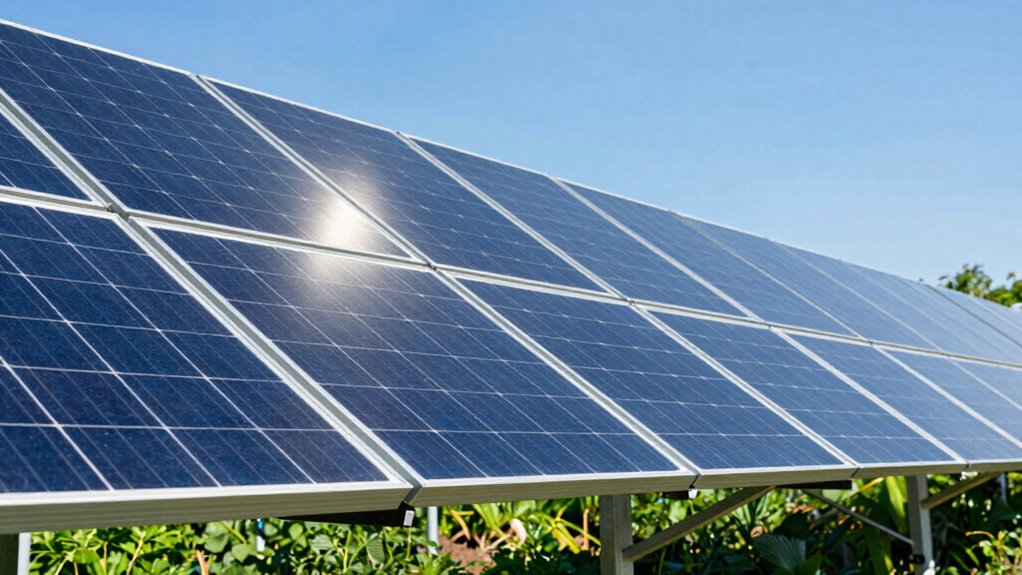
The angle at which you install your solar panels directly impacts how much sunlight they capture throughout the day. Proper solar panel orientation guarantees you maximize exposure to direct sunlight, boosting efficiency. If panels aren’t aligned correctly, shading effects from nearby objects or structures can considerably reduce energy production. Even small shading effects can cause substantial drops in output, so positioning panels to avoid shadows during peak sunlight hours is essential. Adjusting the tilt angle helps optimize sunlight absorption based on your location’s latitude, ensuring your panels face the sun at the right time. By paying attention to both orientation and shading effects, you enhance your solar system’s performance and get the most out of your setup.
How to Find the Best Solar Panel Angle for Your Location
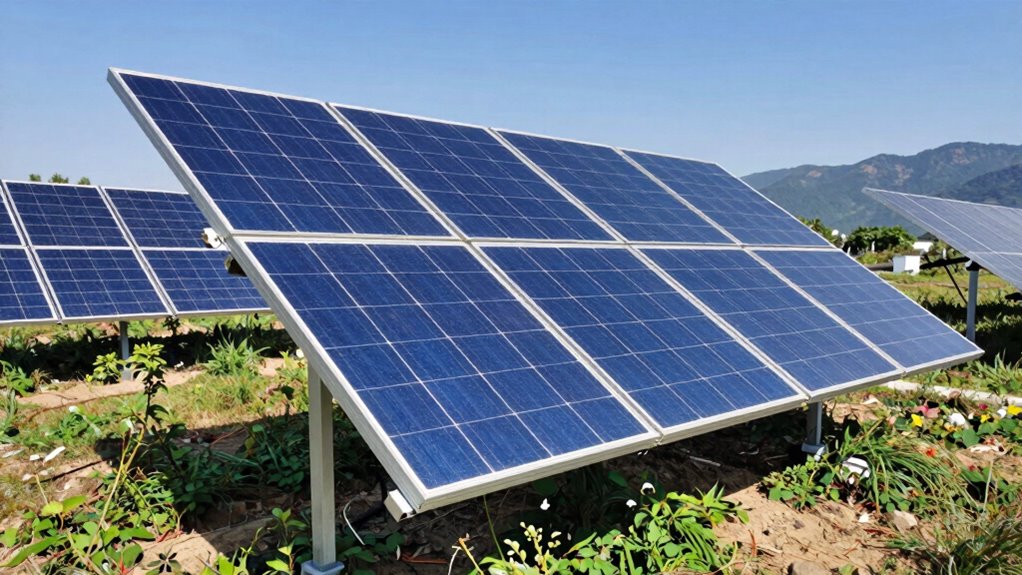
To find the best solar panel angle for your location, start by determining your latitude. This measurement helps you set an ideal fixed angle, maximizing solar panel efficiency. Your solar panel orientation should face true south in the Northern Hemisphere or true north in the Southern Hemisphere for the best exposure. Keep in mind that a fixed angle close to your latitude generally works well year-round. If you want to boost charge speed, consider sun tracking systems, which automatically adjust the panel’s tilt throughout the day to follow the sun’s path. This approach maximizes sunlight capture, especially during peak hours. Ultimately, finding the right angle involves balancing your location’s latitude, solar panel orientation, and the potential benefits of sun tracking technology.
Adjusting Your Solar Panels for Seasons and Sun Paths
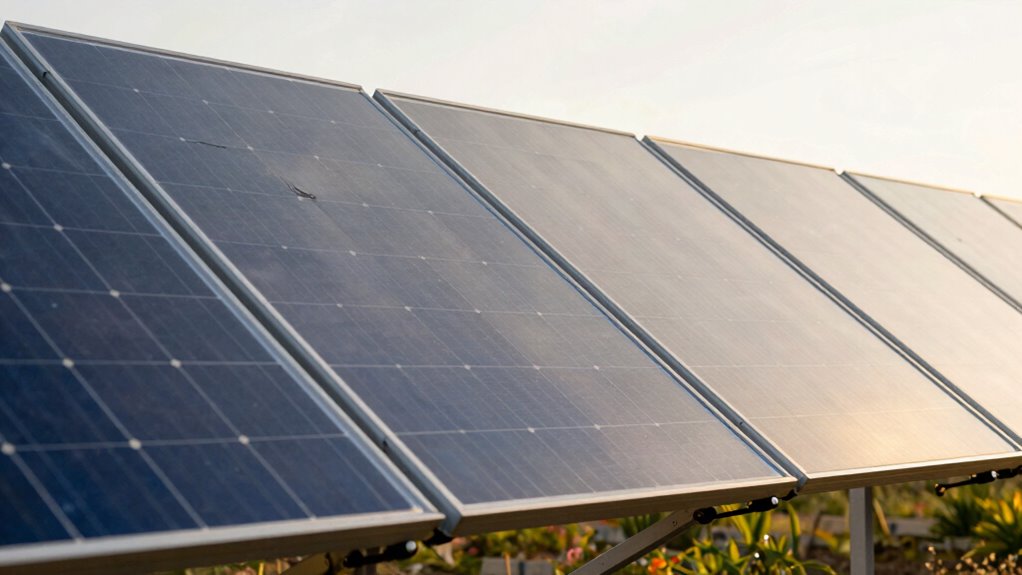
Since the sun’s path changes with the seasons, adjusting your solar panels guarantees they capture the maximum sunlight year-round. Regularly modifying your panel angles enhances your solar system’s efficiency, especially for off grid solar systems where essential performance is paramount. To keep your system running smoothly, perform solar panel maintenance and seasonal adjustments. Here are some tips to help you stay on track:
- Change tilt angles as seasons shift to optimize sunlight exposure
- Track sun movement to maintain maximum efficiency
- Clean panels regularly to remove dust and debris
- Check mounting hardware for stability
- Monitor system performance to identify any issues early
Tools and Tips for Setting and Maintaining the Correct Panel Tilt
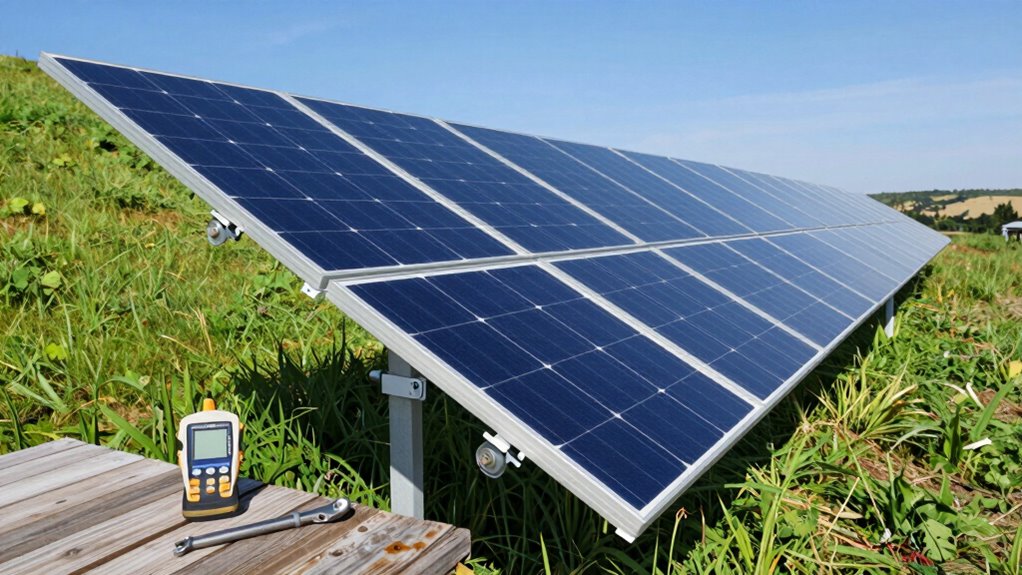
Setting and maintaining the correct panel tilt requires the right tools and a bit of know-how. To do this effectively, you’ll need reliable angle measurement tools like a digital inclinometer or a smartphone app with a level function. These tools help you accurately determine the ideal tilt angle based on your location and season. When adjusting your panels, use proper mounting techniques to ensure stability and ease of future adjustments. Secure the mounting brackets firmly, and double-check the angle after any change. Regularly verifying the tilt with measurement tools helps sustain ideal positioning, especially if weather or shifting supports cause misalignment. With the right tools and techniques, you can keep your solar panels precisely angled for maximum efficiency and energy output.
Common Mistakes When Adjusting Solar Panel Angles and How to Avoid Them
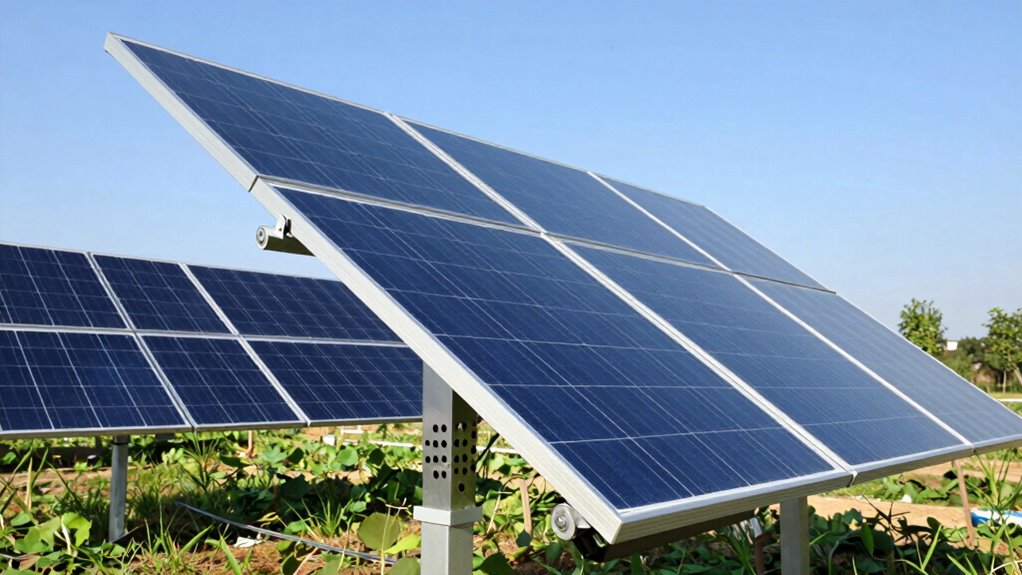
One common mistake when adjusting solar panel angles is neglecting to contemplate seasonal changes, which can lead to suboptimal energy production. Incorrect panel tilt can reduce efficiency, especially if you ignore shading issues or fail to adapt to the sun’s movement. To avoid these pitfalls, remember to:
Neglecting seasonal adjustments can decrease solar efficiency and energy output.
- Set your panel tilt seasonally for maximum sunlight exposure
- Regularly check for shading issues caused by nearby objects or debris
- Avoid a fixed angle if your location experiences significant seasonal variation
- Don’t overlook the importance of maintaining a clear, unobstructed path for sunlight
- Reassess angles after extreme weather to prevent misalignment
Frequently Asked Questions
How Often Should I Recheck and Adjust My Solar Panel Angles?
You should recheck and adjust your solar panel angles seasonally, ideally every three to six months, to guarantee peak performance. Incorporate a regular maintenance schedule to keep panels clean and functioning efficiently. Seasonal adjustments help maximize sunlight exposure as the sun’s position changes throughout the year. Keep an eye on your system’s output; if you notice a decline, it might be time for another angle check and adjustment.
Can Adjustable Mounts Improve Solar Panel Performance Over Fixed Ones?
You’ll find that adjustable mounts, like rotational mounts, notably outperform fixed positioning by allowing you to optimize panel angles daily. The coincidence is that adjusting your panels to follow the sun’s path maximizes sunlight exposure, boosting efficiency. Fixed positioning can’t adapt to seasonal changes, reducing performance. So, investing in adjustable mounts means you get more power and faster charging, especially as the sun shifts throughout the year.
What Impact Do Shading and Obstructions Have on Optimal Panel Angles?
Shading effects and obstructions can considerably decrease your solar panel’s efficiency, especially if they block direct sunlight at ideal angles. To mitigate these issues, you should adjust your panels to minimize shading during peak sunlight hours and consider obstruction mitigation strategies like trimming nearby trees or repositioning panels. Properly accounting for shading effects ensures your panels maintain maximum exposure, boosting charge speed and overall system performance.
Are There Automated Systems to Optimize Panel Angles Throughout the Day?
Automated tracking systems are available to optimize panel angles throughout the day, ensuring you get the most solar power. These systems use advanced sensors and motors for angle optimization, moving your panels to follow the sun’s path. Think of it as having a personal assistant that works tirelessly to boost your energy harvest, so you don’t have to lift a finger. This technology truly puts you ahead of the game!
How Do Weather Conditions Affect the Ideal Panel Tilt Adjustments?
Weather variation and seasonal adjustments markedly impact your ideal panel tilt. Cloud cover, rain, or snow can reduce sunlight, so you might want to adjust your panels to maximize exposure during clear days. Seasonal changes require you to tilt your panels differently—steeper in winter to capture low-angle sunlight and flatter in summer for higher sun. Regularly monitoring weather patterns helps optimize energy capture and maintain efficient charging.
Conclusion
Getting your solar panel angles right is like tuning a fine instrument—you’ll reveal the full harmony of sunlight and efficiency. By understanding seasonal shifts and using the right tools, you can boost your charge speed and maximize your solar setup. Don’t let common mistakes throw you off course; instead, stay proactive. Remember, in solar energy, as in life, the right angle can turn sunlight into a steady stream of power, fueling your independence.
Halloween Picks
halloween
As an affiliate, we earn on qualifying purchases.